


Affiliate disclosure: Some links in this article are affiliate links, which means I may earn a small commission if you make a purchase, at no extra cost to you. My Hume Body Pod link is a referral link specifically: if you sign up through it, you get $20 off and I receive a $20 credit, so there is a direct benefit to you as well as to me. My Eight Sleep link is also a referral link: it saves you up to $350 on a Pod 5 and I receive a $100 credit. I only recommend products I actually use and that have made a real difference in my own results. This article shares my personal health journey and lab data. It is not medical advice. Please talk to your own doctor before starting any new supplement, exercise program, or health protocol, especially if you have an existing condition.
I did the scan in my bedroom, first thing in the morning, without a stitch of clothing on, because apparently even a T-shirt is enough to throw off the reading and the whole point was accuracy. I stood on the scale part of the machine in bare feet, holding a handle out directly in front of me at chest height the way the instructions told me to, and I watched a little progress bar creep across the screen while it measured me down to the cell. I remember thinking, this is just a fancy scale, how bad can it be.
The results landed on my phone a minute later. I sat down on the edge of the bed and just stared at the screen.
What Metabolic Age Actually Tells You
Before I get into what I changed, it is worth understanding what metabolic age actually measures, because it is not the depressing verdict it sounds like. It is, in fact, the most hopeful number I have ever seen on a report. Which is saying something, because I work in finance.
Metabolic age is derived from your basal metabolic rate, your muscle-to-fat ratio, your visceral fat, and your body water levels, then mapped against average values for people your chronological age. When your metabolic age is higher than your real age, it typically means you have less lean mass, more stored fat (particularly the dangerous visceral kind around your organs), and a slower-burning cellular engine than average for your peer group.
Translation: I had the metabolism of a woman who had given up. I had not given up. I had just been extremely busy giving up slowly, one twelve-hour workday at a time.
Here is the part that matters: you can change it. Unlike your birth certificate, metabolic age responds to behavior. That is the entire point.
I had spent years reading the research from people like Dr. Peter Attia (Outlive) and Dr. Casey Means (Good Energy) and feeling vaguely inspired and then returning to my desk for another twelve-hour workday. What the Body Pod did was convert abstract science into a personal number with my name on it. That changes things. Inspiration is optional. A number that makes you want to argue with a machine is not.
Why I Refused to Overhaul Everything at Once
Here is what I did not do in the days after that scan. I did not join a gym and commit to an hour a day, seven days a week. I did not pour every bottle of wine in the house down the drain and declare a lifetime of sobriety on the spot. I did not throw out my pantry and start over with a diet plan I found online.
I have watched enough people, myself included, torch their motivation with a plan that demands perfection starting Monday. It works for about twelve days. Then real life happens, a deadline lands, a grandchild gets sick, a board call runs long, and the plan collapses because it never had any give in it. I was not willing to build something that fragile.
Instead I did what I do professionally when I am facing a system I do not fully understand yet. I picked one variable, changed only that one thing, and watched what happened before I touched anything else. Researchers call this habit stacking: you attach one small new behavior to something you already do reliably, let it become automatic, and only then does it become the foundation the next habit can stand on. You are not white knuckling your way into a new identity overnight. You are building one, one small brick at a time, in a way your nervous system can actually tolerate without staging a revolt.
That decision, more than any single product or protocol, is the real reason any of this held for longer than a few weeks. So before I walk you through what I actually did, I want to be honest about the order I did it in, because the sequence matters as much as the substance.
Shift One: Before the Laptop, Not After
The very first thing I changed had nothing to do with exercise. It was the first fifteen minutes of my morning.
I work for a demanding CEO whose calls can start early and escalate fast, the kind of high stakes portfolio conversations where my heart rate visibly jumps on my Apple Watch the moment his name shows up on my phone. I used to reach for my laptop the second I woke up, because that is what the job seemed to demand. But once I am at that computer, I do not resurface for hours. If a healthy habit had not happened before I opened it, it was not happening that day at all.
So the new rule became simple: water, a scoop of protein, my morning supplements, and a few minutes outside in the sun with Roo, before the laptop opens. Not after. Before. I use Naked Whey protein powder because the ingredient list is short and it blends easily into a quick morning shake, and I built the rest of the sequence around Nordic Naturals Ultimate Omega, vitamin D3 plus K2, and magnesium glycinate, which I take in the evening for sleep and muscle recovery.
None of that required a gym membership or a single dollar spent on equipment. It required deciding, once, what the first fifteen minutes of my day would look like, and then defending that fifteen minutes the way I would defend a client deadline. It sounds almost too small to matter. It turned out to be the highest leverage change I made in this entire process, because it protected the door that every other habit had to walk through.
Shift Two: Letting My Own Data Talk Me Into Things
Once that morning sequence held for a few weeks without me having to think about it, I felt steady enough to add the next layer. That is when I started wearing a Libre 3 continuous glucose monitor.
I need to be straight with you about how I got mine, because it was not normal. My day job is finance for a group of about twenty companies, and one of them sells glucose monitors. I asked the warehouse to send me one. No appointment, no prescription conversation, no insurance call. That is not a path available to you, and it would be dishonest of me to write about wearing one without saying so.
The Libre 3 is a prescription device built for people managing diabetes. I am not diabetic. If you want the same kind of data I got, the realistic route now is an over the counter sensor: Dexcom Stelo at around $60, or Abbott Lingo at around $49. Both are cleared for adults without diabetes, both are sold on Amazon, and neither needs a doctor. I have not worn either one, so I cannot compare them to the Libre 3 from experience, though as I write this Stelo is rated noticeably higher of the two.
I will be honest, this became a little addictive, in the best way. I could watch my glucose rise and fall on my phone in real time after every single thing I ate. Nutrition stopped being a set of rules some article told me to follow and became direct, personal feedback I could actually see happening inside my own body. One evening I took a short walk with Roo after dinner mostly out of curiosity, and I watched my glucose curve flatten out on the graph almost immediately. I have never needed more convincing than my own data laid out in front of me. That one walk became a habit within a week, because I had proof, not just advice.
Shift Three: The Wine, Told Honestly
I like wine. I am not going to pretend otherwise in this article, because I think pretending is exactly what keeps most of us stuck. But once the CGM had me paying closer attention to my own patterns, I could not help but notice what alcohol was doing to my sleep. I track sleep three ways, which is either thorough or slightly ridiculous depending on who you ask: my Apple Watch, my Hume band, and the Pod by Eight Sleep. When all three agree, I believe them.
The Pod is the one I would fight someone over. It tracks sleep, yes, but that is not why I love it. It is delightfully, ridiculously delicious. I climb into crisp cool sheets, which is the best feeling in the world, and then it does something clever: it keeps the bed cool while I am in deep sleep, and warms it up when I move into REM, which is the temperature REM actually wants. It is engineering a good night’s sleep underneath me while I am unconscious and taking no credit for it. My sleep has genuinely never been better, and my referral link saves you up to $350 on a Pod 5. If you want the long version of what it is and what it actually does, I wrote a full review here.
I should confess something, because it is relevant. My powers of rationalization are exceptional. Legendary, in certain circles. And for most of my adult life I had rationalized sleep into a personality trait. I was proud of how little I needed. Five hours and a coffee and I could still run a board call, and I told that story about myself the way you would tell it about a strength.
Outlive and Good Energy took that away from me, and I am glad they did. What I had been calling toughness was me quietly trading years of my own health for a few extra hours of email. We spend eight hours a night in bed, or we hope to. That is a third of your life. I had spent decades treating a third of my life as the part that did not count.
I did not quit. I ran a Dry January, and later a full Dry April, as deliberate single variable experiments rather than permanent declarations, the same way I would test one change in a financial model before committing to it. What I learned surprised me. It was not only how much I drank. It was when. A glass of wine early in the evening, well ahead of bedtime, had a noticeably different effect on my overnight recovery numbers than the exact same glass an hour before I went to sleep. That one insight, timing over total elimination, has done more for my sleep and my sense of feeling rested than almost anything else on this entire list, and it came from watching my own data, not from willpower or guilt.
Shift Four: Turning an Empty Bedroom Into a Reason to Move
My son moved out of his childhood bedroom last year, and rather than let it sit empty, we turned it into a wellness room.
In my head, the wellness room was muted mauve. Maybe lavender. A plant room, really, with good light, a yoga mat, possibly an exercise ball. Something serene.
Then I described this vision to my husband.
The room now has rubber mats, a Smith machine, a rack of weights, and just barely enough floor left for a yoga mat if I push things aside. It is not serene. It is a small gym in a house in Florida, and it was absolutely the right call, because muscle does not get built on a yoga mat and I needed muscle more than I needed lavender. I do still miss the plant.

This is the point in the story where the physical training piece finally arrived, and it arrived slowly, on purpose, with my knee arthritis at the center of every decision.
The centerpiece is a Major Fitness Drone2 Advanced Smith machine, which lets me build real strength with a guided, controlled bar path that is far gentler on my knee than free weights or a standard barbell setup would be. Once that habit was reliably three days a week, I added a ProForm SpaceSaver rower for what is called Zone 2 cardio, a pace easy enough to hold a conversation but sustained long enough to build real aerobic base. After that came a Flo Pilates reformer for low impact core and mobility work, which is referred to in this house as Satan. If you buy one you will understand why. I cannot find the blessed thing online anymore, and I suspect there is a reason for that. Finally came two recovery tools that made the training sustainable rather than something my body dreaded: a NeurocarePro red light therapy mat and a Pulsetto vagus nerve stimulator for the mornings when a stressful call has my nervous system revved up before nine.
I want to be honest about the order again, because I think it is the part people skip past. The Smith machine came first, and only first. Every single piece after it was added only once the habit before it no longer required willpower to maintain. If I had bought all of this equipment on day one, most of it would be gathering dust in that room right now, and I know that about myself, so I planned around it.
The Framework Underneath All of It
None of this was improvised. Two books shaped nearly every decision I made along the way, and I recommend both without reservation to any woman looking at her own numbers for the first time and wondering where to even begin.
Good Energy by Dr. Casey Means reframed metabolic health for me as a cellular energy issue rather than a willpower issue. Her central argument, that a great deal of modern chronic disease traces back to how well our mitochondria are functioning, is what pushed me to actually care about my continuous glucose data and my lab markers like ApoB, not just the number on the scale that started this whole story.
Outlive by Dr. Peter Attia gave me the training framework that made the wellness room make sense. Zone 2 cardio for mitochondrial density and metabolic flexibility. Strength training to preserve lean muscle mass as we age, since muscle is one of the strongest predictors of how well we function later in life. And a focus on healthspan, the years you spend actually able to do the things you love, rather than lifespan alone. His idea of identifying the physical tasks you want to still be able to do in your nineties, and training backward from there, changed how I think about every single workout I do now. I want to be the grandmother who gets down on the floor to play and gets back up without needing a hand. That is the actual goal. The scale was only ever the first data point that pointed me toward it.
I read Outlive first, but if you are only going to read one, start with Good Energy. It is the one that reframes how you think about your own body, and it is the reason I started caring about the numbers underneath the scale. Read Outlive second, for the training framework.
The Numbers, Because I Promised You Data
I told you at the start of this that I do not manage numbers by looking away from them, and I am not going to start now. These are my actual results. The body composition numbers are from a scan I ran this week, not a flattering one I saved from the spring. I will keep updating this table as new scans and labs come in, including the ones that go the wrong way.

| Metric | September (start) | April (best) | Now |
|---|---|---|---|
| Weight | 160.7 lbs | 141.5 lbs | 144.4 lbs |
| Body fat percentage | 34.6% | 27.5% | 29.4% |
| Body fat mass | 55.6 lbs | 39.0 lbs | 42.4 lbs |
| Lean mass | 97.9 lbs | 95.8 lbs | 95.3 lbs |
| Metabolic age | 70 | 62 | 65 |
| Visceral fat index | 12 | 9 | |
| ApoB | 111 (Feb 2026) | 80 (Aug 2026) | |
| Triglycerides | 169 (Jan 2025) | 81 (Aug 2026) | |
| HDL | 61 (Jan 2025) | 75 (Aug 2026) |
I also want to name something my lab work taught me the hard way. A genuinely good result in one area can make you stop looking closely at everything else. My lipid panel looked strong, and it very nearly caused me to skim past a couple of other findings on the same report that needed real follow up with my doctor. Do not let one good number talk you out of reading the entire report.
What I Would Tell You If You Are Standing Where I Was
If you recognize yourself somewhere in this story, the long hours at a desk, the wine that quietly drifted from occasional to nightly, a knee or a hip or a back that makes “just start running” feel like a punchline rather than useful advice, here is what I actually want you to take away from all of this.
You do not need the wellness room. You do not need the Smith machine, or the continuous glucose monitor, or any single product I have linked in this article. All of that came later, and each piece was only earned by the habit that came directly before it. What you need this week is one small, honest shift you can actually sustain. Water before coffee. A ten minute walk after dinner. Simply noticing when the second glass of wine happens, rather than pretending you did not notice or, worse yet, buying larger glasses. Pick one. Let it get boring and automatic. Only then add the next one.
Progress, not perfection, one intention at a time. That is not just our tagline here at Enlightenzz. Eleven months and twenty two pounds into this, it is the only method that has ever actually worked for me.
—
The products linked above are ones I personally use and have researched carefully, including consulting with my own physician on anything involving prescription devices or supplements that interact with medication. Your body, your history, and your medical needs are your own. Please loop in your doctor before making changes, particularly around alcohol reduction, new supplements, or any new exercise program if you have joint issues, cardiovascular history, or other health conditions.
What Happened When I Stopped
I could end this story on the best numbers I ever posted. At my lowest I was 141.5 pounds with a metabolic age of 62, and if I stopped typing there you would close the tab thinking it wrapped up neatly.
Here is where I actually am, this week.
Still a long way from where I started. Not where I was in the spring.
This fall got heavy. Work stacked up, the calendar filled with other people’s priorities the way it always does, and the workouts went first, because they are the only thing on my list with nobody else waiting on them. Nobody sends a follow-up email when you skip the rower.
I expected the scale to move. What I did not expect was which numbers moved.
The Three Scans, In Order
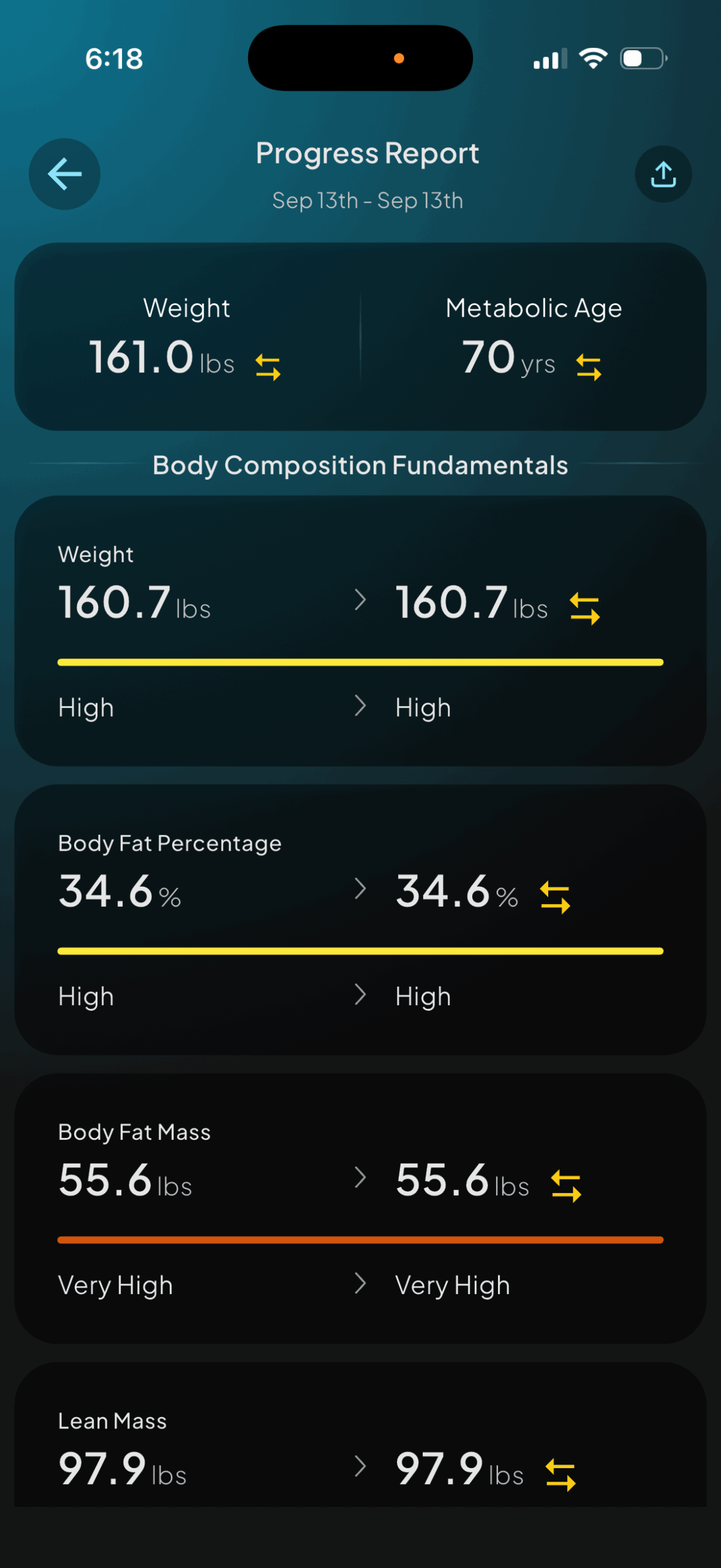
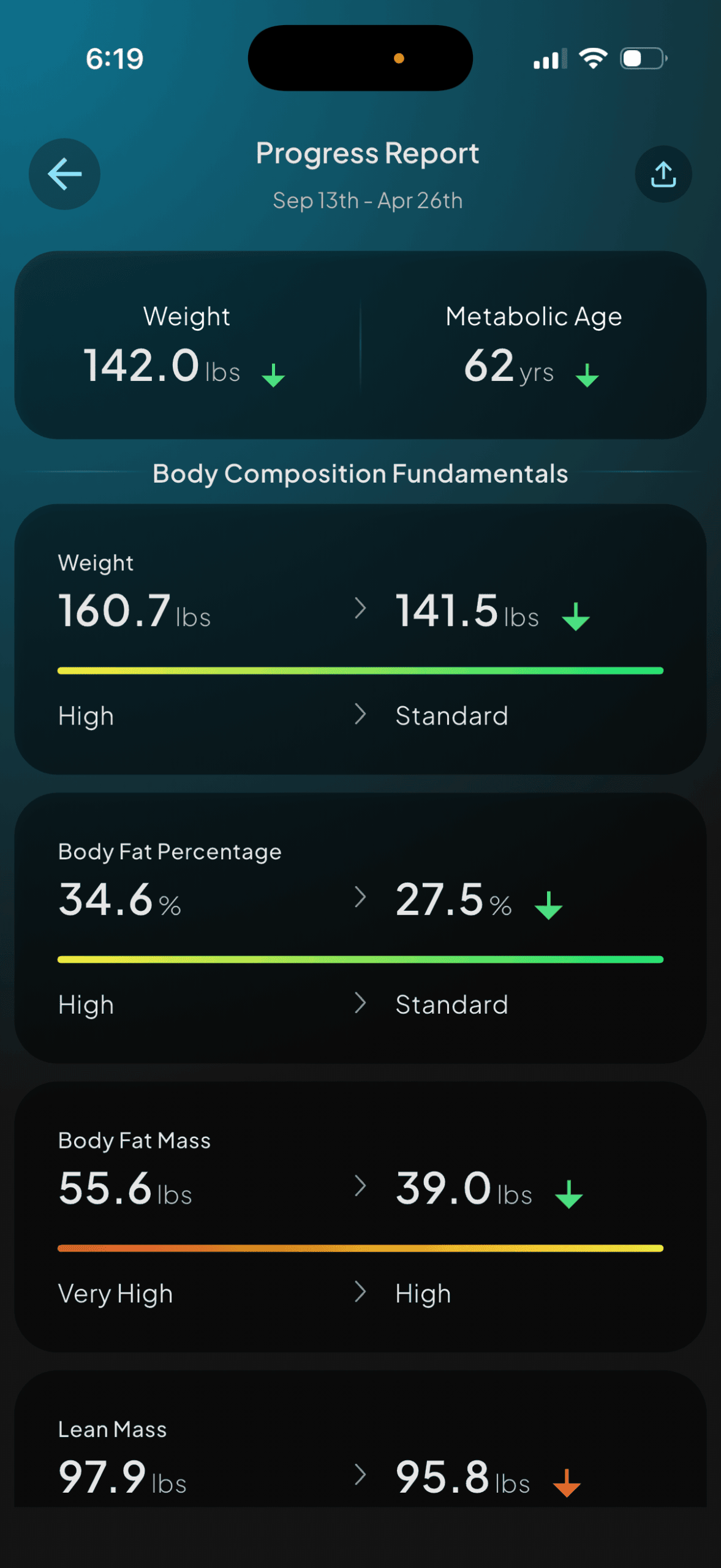
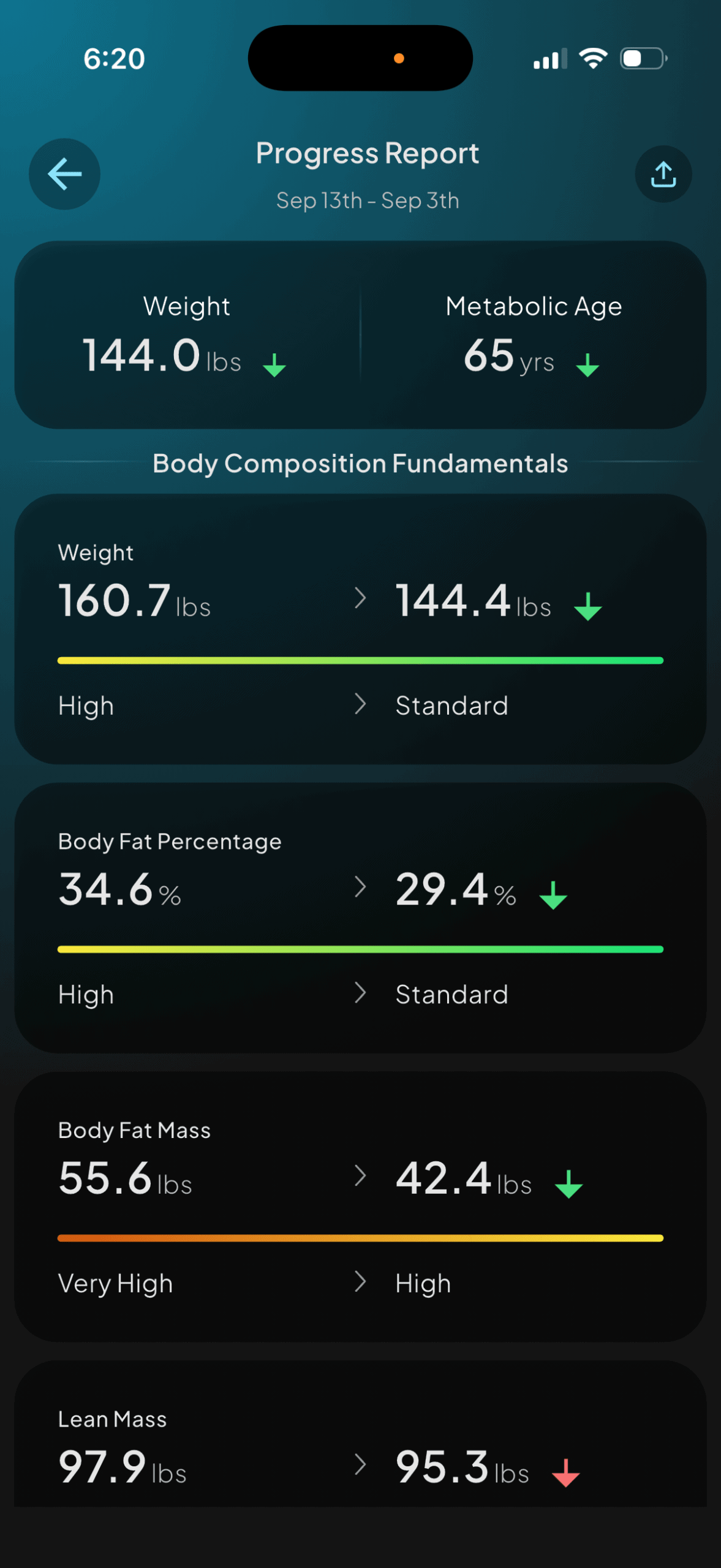
Weight: 160.7 pounds. Body fat: 34.6 percent. Metabolic age: 70. Not so bad, unless you are actually only 61 years old.
I want to tell you I took it in stride. I did not. I felt something close to grief sitting there on the edge of the bed, which surprised me, because I am not usually a person who lets a number take the wind out of me. I run finance and compliance for a portfolio of companies. I have spent decades looking at hard numbers without flinching, catching a discrepancy on a bank reconciliation before it becomes a real problem, staying calm when other people are not. But this number was about me, and it would not sit still on a spreadsheet where I could manage it from a comfortable distance. I got dressed, walked out to find my husband, and more or less wailed the whole thing at him. Not my finest, most composed moment. But an honest one.
If you do not know me, here is the short version. I am a CFO in my sixties. I oversee finance for close to twenty companies, which means my calendar belongs to other people more often than it belongs to me. I sit at a computer up to twelve hours some days. I have arthritis in my right knee, which rules out a lot of the advice you read about “just start running” or “do burpees.” I have a husband, a dog named Roo who anchors my whole day, and a backyard full of chickens who could not care less about my metabolic age. And at the point this story starts, I also had a glass of wine most evenings that had quietly drifted from an occasional treat into a nightly habit I was not examining very closely.
That was the person who stepped onto the Hume Body Pod for the first time. This is the story of what she did about it, in small enough steps that I actually stuck with them.
The Muscle Did Not Leave When I Stopped. It Left While I Was Winning.
| September | April | Now | |
|---|---|---|---|
| Lean mass | 97.9 lbs | 95.8 lbs | 95.3 lbs |
| Body fat mass | 55.6 lbs | 39.0 lbs | 42.4 lbs |
Look at where the lean mass actually went.
I lost 2.1 pounds of it between September and April, during the stretch I would have described as going brilliantly. Nineteen pounds down. Body fat from 34.6 to 27.5. Metabolic age from 70 to 62. Everything moving in the right direction, and underneath all of it I was quietly shedding muscle I could not afford to lose.
Then the drift. Since April I have put back about three pounds, and nearly all of it is fat: body fat mass up from 39.0 to 42.4. Lean mass barely moved, 95.8 to 95.3.
So the story is not that I stopped lifting and my muscle fell off a cliff. It is quieter than that, and I think far more common. The muscle came off while I was succeeding, because I was losing weight faster than I was building strength, and the scale congratulated me every single week for it. Then I stopped lifting, and I never got the chance to put it back.
At 62, that is the number that matters. Muscle is what decides whether I get up off the floor at 80. It is the whole argument of Peter Attia’s Outlive, a book I had already read and recommended and apparently needed to read again.
My Body Pod grades my body composition a C, with one line of feedback: focus on your muscle mass. That stung more than the original 70 did, and it should have.
What Did Not Drift
Here is the other half, and it matters.
Six days before I wrote this, my bloodwork came back the best it has ever been. Triglycerides at 81, against 297 in 2020 and 246 in 2022. The first normal triglyceride number in my recorded history. ApoB down from 111 in February to 80. HDL up fourteen points. Total cholesterol down twenty-eight.
My cardiovascular score came back A+ in the same report that gave my body composition a C.
So the habits that survived the busy season, the protein in the morning, the supplements, the sleep, the walking, the wine I mostly stopped drinking, kept doing their work without me thinking about them. Those were the ones I had made small enough to survive a hard quarter. The lifting was not, and lifting is the one that protects the muscle.
That is not a failure of willpower. It is a design flaw in how I built the plan, and design flaws are fixable.
What I Am Doing About It
I started last week. Not a plan I am going to start, not a Monday I have picked out. Last week.
Strength work first, before cardio, before anything else, on the Smith machine I already own. Short sessions, because a plan that needs a good week to happen is not a plan, and I have just finished proving that to myself in front of witnesses.
I do not have new numbers yet. Muscle does not come back in seven days, and I am not going to pretend otherwise to give this article a tidier finish. What I have is a scan that told me something true, and a week of doing the thing it pointed at. I will update this page when the next scan comes in, whichever direction it goes.
If you are somewhere in your own drift right now, deciding whether the whole thing was a waste, do not check the scale. Check what is underneath it. You may find, like I did, that the foundation held and the roof needs work, and that starting from here is nothing like starting from where I began.
I started at a metabolic age of 70. I am at 65. I was at 62, and I would like to be there again.
That is the honest ending, and it is the one I would have wanted to read.



