

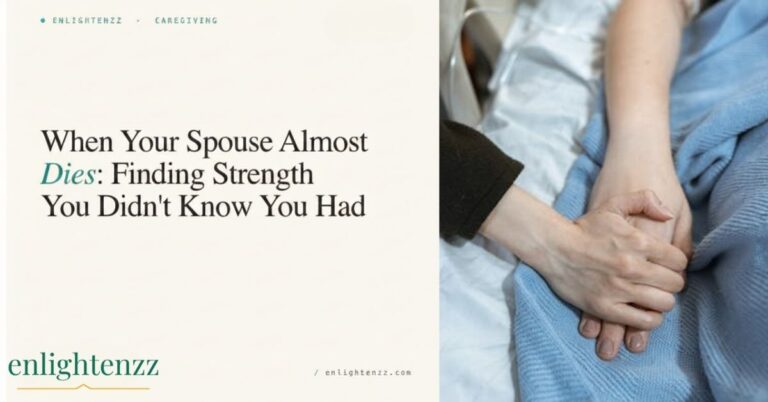
What nobody tells you about supporting a spouse through long term illness, the kind that does not end in thirty days.
I am writing this on a Saturday in May, three weeks before my husband Curtis goes in for his third major surgery. The date is June 9. Tampa General Hospital. A surgical team we trust doing work that is complicated enough that we have already had the conversation about what happens if things do not go as planned.
I am telling you that upfront because I want you to understand that this is not a piece about a crisis that is behind me. It is a piece written from inside one. What I know about supporting a spouse through long term illness I did not learn from a book. I learned it from nineteen months of living it. And I think that is exactly why it might be useful to you.
The October That Rearranged Everything
Curtis and I have been together for decades. He is the calm one. The even-keeled one. The man who decided three weeks into dating me that he was going to marry me, and turned out to be right. He fishes. He rides his Harley. He cooks when his body lets him. He is the person who, when everything else is loud, makes things quiet.
On October 2, 2024, his body stopped cooperating.
What started as abdominal surgery landed him in the ICU for two weeks and then in the hospital for a month. He came home with an ostomy, which was hard, and we adapted to it the way you adapt to things when you love someone and the alternative is unthinkable. We learned the routines. We made it work. We made plans for the reversal surgery and held onto those plans like something solid.
The reversal came in September 2025. That is when everything got complicated.
During that surgery his bowel was perforated and his ureter was torn. What should have been the surgery that closed this chapter became the surgery that opened a much harder one. A fistula developed. He ended up on TPN, which is nutrition delivered directly into the bloodstream through a PICC line, because his digestive system needed time to rest and heal. He has been on it since. We have been living inside this medical reality since October 2, 2024, and June 9 will be the third major attempt to repair what needs repairing.
I am not going to bury that in a list of coping strategies and call it an article. You deserve the real version.
What Supporting a Spouse Through Long Term Illness Actually Looks Like from the Inside
Every piece of content I have ever seen about supporting a spouse through illness describes an event. A diagnosis, a treatment, a recovery. A beginning, middle and end.
Curtis’s situation does not have that shape. It has had waves. Periods of hope followed by setbacks. Numbers that trend in the right direction and then a phone call that changes the picture. Surgeries scheduled and rescheduled. Insurance companies that need to be managed as a second job. A PICC line that requires daily care. TPN bags that need to be changed. Wound care. Medication coordination across multiple specialists who do not always talk to each other as much as you would like.
And alongside all of that: a full-time career managing finance across a portfolio of companies. A wellness practice I have built deliberately because I know what stress does to a body over time and I refuse to let this destroy mine while I am trying to hold everything else together. A dog who still needs walking. Chickens who remain entirely unbothered by human suffering. The ordinary machinery of a life that does not pause for crisis.
Here is what supporting a spouse through long term illness has taught me, from the inside of nineteen months of it.
The hardest part is not the hard days. The hardest part is the relentlessness of it. The way it does not resolve. The way hope and fear become something you carry simultaneously, every single day, until you stop noticing that you are carrying them because they have simply become part of your body weight.
You will become someone you did not know you were. I have become a person who understands fistulas, anastomotic leaks, ureteral reimplantation, and the difference between what a number on a lab report means and what it means for this specific patient. I did not choose to become that person. I became her anyway, because Curtis needed an advocate and I was the one in the room. That is the only version of me that has ever mattered to me .
version that has ever mattered to me.
The performing bravery phase has a cost. For a long time, Curtis and I were each trying to protect the other. He was not telling me how scared he was. I was not telling him how scared I was. We were both performing a version of okay that neither of us fully felt. We eventually broke from that. Had the honest conversation. Named the fear out loud between us. That moment, difficult as it was, brought us closer than we have been in twenty years of marriage. I would not trade it. But I wish we had gotten there sooner.
Being busy is not avoidance. Sometimes it is survival. I have not stopped working, building, writing, or moving my body through any of this. Some people would call that denial. I call it knowing myself. Staying in motion keeps me from ruminating. Rumination, for me, is where the darkness lives. The wellness room I built in my son Tyler’s old bedroom, the morning ritual that holds whether the rest of the day does or not, the daily walks with my dog Roo: these are not luxuries. They are the infrastructure that keeps me functional for the person who needs me functional.
What I Want You to Know If You Are Supporting a Spouse Through Long Term Illness
If you are reading this because a search brought you here at midnight, which is the hour when women in this situation do their searching, here is what I want to say directly to you.
This is not a sprint and it may not be a marathon with a finish line. Some medical situations resolve cleanly. Some do not. If yours is one of the ones that keeps going, you are not doing it wrong. You are just in the harder version, and the harder version requires a different kind of endurance than anyone prepares you for.
Your health is not optional. I know that sounds obvious. I also know that when someone you love is sick, your own body starts to feel like a low priority. It is not. You cannot run on cortisol and coffee indefinitely without your own health paying the price. I track my metrics obsessively, not because I am a wellness influencer, but because I have watched stress show up in my bloodwork in real time and I refuse to become the second patient in this marriage. Eat the protein. Walk the dog. Sleep as much as your situation allows. These are not indulgences. They are strategy.
Find the one person you can be completely honest with. Not the person you perform okay for. The person you can call and say the true thing to. For some women that is a best friend. For some it is a therapist. For some it is a journal or, honestly, an AI that never flinches and never needs you to be okay for its comfort. Wherever you find that space, use it. The weight of unspoken fear is heavier than spoken fear. Always.
Accept help without apologizing for needing it. This one took me longer than I would like to admit. I am someone who has been self-sufficient since I was twelve years old and earning my own money. Receiving help felt like losing something. What I have learned is that it is not losing something. It is letting people who love you participate in something that matters. Let them.
Joy is not a betrayal. You are allowed to laugh. To have a good dinner. To enjoy something, even on a hard week. The chickens in my backyard have given me more uncomplicated joy this year than almost anything else in my life, and so did Dutch Pour painting. I have learned to receive that without guilt. Delight where you can find it is not disrespectful to the seriousness of what you are carrying. It is how you survive carrying it.
Three Weeks Out
June 9 is three weeks away as I write this. Curtis and I are doing the things you do when a major surgery is approaching. Practical things, paperwork things, conversation things. We have talked about what we are afraid of. We have also talked about Philippe Park, where we are going to take the restored 1969 Boston Whaler once he is on the other side of this and his body is his again. We have plans. Plans matter. They give the fear something to stand next to.
I do not know how June 9 goes. I know the surgeon. I know the team. I know that Curtis has fought since October 2, 2024 with a kind of quiet stubbornness that I find both maddening and deeply moving. I know that I will be there. I know that whatever happens, I will have done everything in my power to advocate for him, care for him, and stay whole enough to be useful to him.
That is all any of us can do. Show up. Stay present. Not perform okay, but actually try to be okay, which is a different and much harder thing.
If you are supporting a spouse through long term illness right now, I see you. I have written before about in a different shape — my brother Jeff and what addiction took. The relentlessness of it, the love that does not stop even when you are exhausted by it, the strength you did not know you had until you needed it.
You have it. I promise you have it.
If this piece found you at the right moment, the Enlightenzz community is full of women navigating the complicated, beautiful, difficult realities of this life stage. [Join us here.]
Susie Adriance is the founder of Enlightenzz.com and a CFO who has spent the last nineteen months learning that the most important spreadsheet she manages is the one tracking her own reserves. She and Curtis are taking it one day at a time, with plans for a 1969 Boston Whaler waiting on the other side.


