

I set quarterly targets for a portfolio of companies for a living. Revenue projections, portfolio assessments, budget variances, I am professionally the person who knows what the numbers say and what needs to happen next. So goal setting after 50, you would imagine, would be easy.
So when I sat down a few years ago to think about goals for my own second half, I did what any self-respecting CFO would do. I opened a spreadsheet.
And then I closed it. And opened a different kind of document entirely.
I called it a joy inventory. Not because I’d read about it somewhere or followed a framework. Because when I asked myself honestly what I was actually trying to move toward, the answers didn’t fit in cells. They looked more like this:
The way steam rises off my coffee on a cool Florida morning. Watching Curtis’s eyes light up with pride as he works on his 1969 Boston Whaler. Holding hands walking across a parking lot, just that, just the ordinary fact of it. The owl calls Curtis makes in the backyard and the owls that answer from across the neighborhood. A black-bellied whistling duck appearing at the feeder one morning, a species I’d never seen before, staying just long enough to be witnessed.
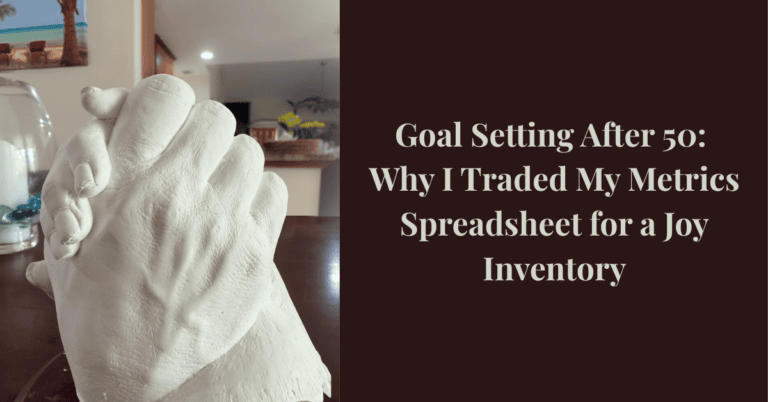
The plaster sculpture of our clasped hands that we made together, you press your hands into the mold and what comes out is this gorgeous, realistic cast of two people holding on. It sits in our home now. No deadline produced that. No KPI pointed toward it.
That’s the joy inventory. And it turned out to be the most clarifying document I’ve ever made.
What Actually Changed About Goals After 50
I want to be honest here because the easy version of this story is “throw out your SMART goals and follow your bliss”, and that’s not what I’m saying.
SMART goals are a good tool. Specific, measurable, achievable, relevant, time-bound, that architecture makes sense. I haven’t abandoned it. In fact, the health transformation I’ve been living for the past eight months has involved real data: a Hume Body Pod, a CGM, bloodwork, HRV tracking. Metabolic age from 69 to 61. Visceral fat from elevated to 8. Those are measurable outcomes and I tracked them deliberately.
What changed wasn’t the measurement. It was the spirit behind the goal.
In my thirties and forties, goals were about proving something. Climbing. Achieving. Demonstrating that the woman who’d bartended to make ends meet and faked her way through a Microsoft Access interview could actually run the room. Those goals had urgency and ego in them, not entirely bad, but not the whole story either.
After 50, the question shifted. Not “what do I need to prove?” but “what leaves me joyful?” Not “what’s the most ambitious target I can set?” but “what’s the smallest change I can make that I’ll actually sustain?”
The health goals didn’t start with a two-hour gym program and a personal trainer. They started with walking Roo one mile a day. Adding 25 grams of protein. Watching my glucose curve on a CGM and adjusting based on what I saw. Tiny, manageable, joyful enough that I kept going. The data followed the joy, not the other way around.
The 5 Mindset Shifts That Will Change Your Life piece goes deeper on how that internal shift actually happens, it’s the thinking infrastructure behind everything else.
I’ve written about how the full arc unfolded in the personal growth plan after 50 piece, the incremental shifts, the catalysts, the stacking. This is the companion piece to that one, focused specifically on what goal-setting looks like when you run it through the joy filter first.
How to Build Your Own Joy Inventory
This isn’t a framework. It’s a question you sit with until the answers get honest.
What makes you lose track of time? Not what you think should make you lose track of time, what actually does. For me it’s Dutch Pour painting, watching the ant saga unfold on the pool deck, sitting outside with my coffee before the day starts.
What do you keep coming back to? The things that surface in quiet moments, on long drives, in the spaces between tasks. The 1969 Whaler Curtis is restoring. The fairy garden I built for Amy during the hardest stretch of his recovery. These aren’t hobbies. They’re signals. How to Trust Your Intuition in Midlife and Beyond is the companion read here, because learning to hear those signals is its own skill.
What would you do if nobody was watching and nothing was being measured? This is the question that cracks open the difference between goals you’ve inherited and goals that are actually yours.
What does ordinary life feel like at its best? Not the highlight reel. The Tuesday evening. Head on Curtis’s shoulder. Looking up into the backyard trees and picking out the mockingbirds, the blue jays, the finches, the cardinals. The comfort of a warm bed at exactly the right temperature on a morning when you don’t have to rush.
Write those things down. All of them. That list is your inventory. And your goals for the second half, the real ones, the ones worth pursuing, will be the things that move you toward more of what’s on it. The Power of Celebrating Small Wins in Midlife is worth reading alongside this, it’s about why the ordinary moments on that list deserve as much attention as the milestone ones.
The Goal That Couldn’t Live in a Spreadsheet
The most significant thing that happened in my second half wasn’t a goal at all. It was a catalyst.
I’ve written about the fear before I acted on it in the overcoming fear after 50 piece. But here’s what it taught me about goals: it wasn’t a goal at all. It didn’t have a timeframe or a success metric. It was a moment where a door opened and I walked through it. What followed couldn’t have been planned or projected. It could only be entered.
The second half of life has more of those moments than the first. Not because we’re lucky, but because we’ve gotten better at recognizing the open door when we see it. And because we’ve learned, finally, that the joy inventory matters as much as the metrics spreadsheet.
Sometimes more.


