


At 59 I stood in Michael’s craft store having a quiet breakdown in aisle 7.
My cart already held yarn (cannot knit), watercolors (cannot paint), calligraphy pens (handwriting like a distressed physician), polymer clay (unclear why), and a bedazzler that I cannot explain to this day. Curtis found me there, staring at the cart like it had personally disappointed me.
“What’s wrong?”
“I don’t have hobbies. I have work and Netflix. I’m boring. I’m going to die boring.”
He looked at the cart. He looked at me. He picked up a Dutch pour paint kit off the nearest shelf and put it in my hands. “You literally just pour paint. Even you can’t mess that up.”
He was wrong. I absolutely could mess it up. My first attempt looked like something a unicorn produced after a very bad day. I loved it anyway. That messy canvas in my kitchen became the beginning of the most unexpected chapter of my creative life, which is a sentence I would not have predicted saying at 59 while crying next to the yarn.
Two years later at 61, I have five hobbies that have genuinely changed my happiness, my brain, and my marriage. Not because I am good at them. I am objectively terrible at most of them. But creating something from nothing rewires you in ways that spreadsheets, which I have been staring at for 30 years, simply do not.
If you think you are not creative, or too old to start, or too busy, or too far past the point where new things take root. I have been all of those things and I am here to tell you that you are wrong.
Dutch Pour Painting: The One That Started Everything
Pour paint on canvas. Tilt canvas. Watch what happens. That is the entire skill set required.
There is no wrong result in Dutch pour painting because everything reads as “abstract art” and nobody can prove otherwise. This is extremely important information for women who have spent decades being evaluated on performance. For twenty minutes you just. pour. Tilt. Watch the colors move into each other. It is more meditative than actual meditation, at least for my particular brain, which does not sit still easily.
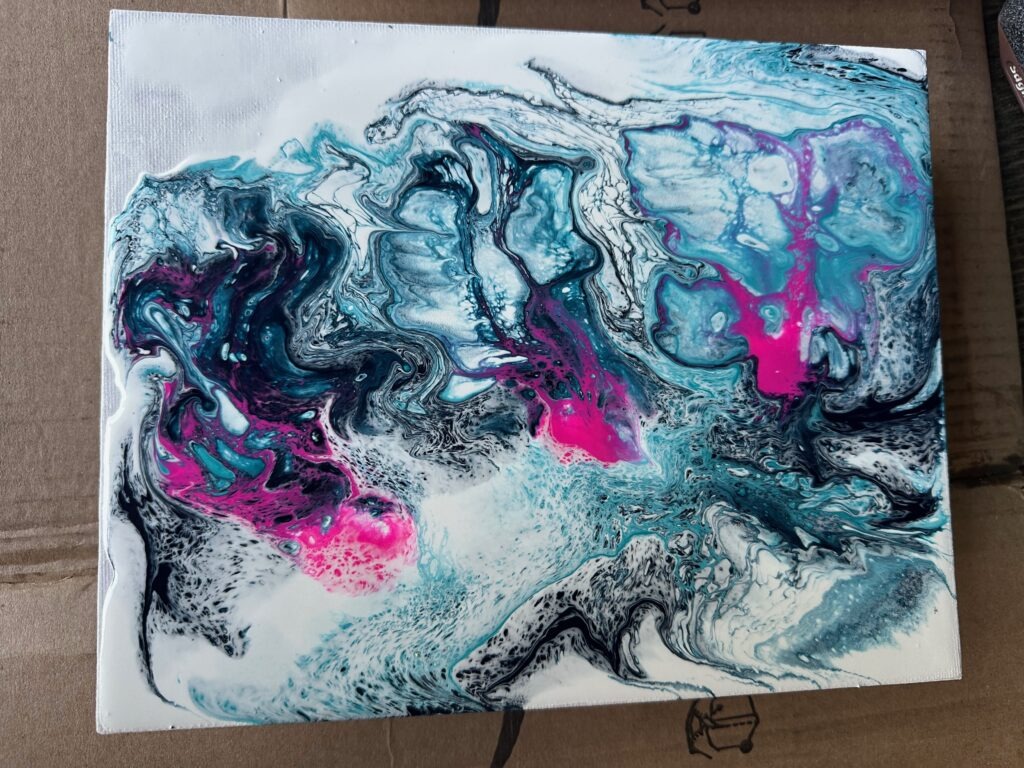
By month one I had made thirty paintings. Kept five, gave away ten, threw away fifteen. By month six I had sold one for fifty dollars, which I found genuinely shocking and still think about sometimes. By year two I had what my family charitably calls “a style,” which is another way of saying consistent happy accidents. If you find yourself wanting to try this, I highly recommend Olga Soby’s course.

Curtis and I paint together sometimes now. Both badly. It is one of my favorite things about my current life that this sentence is true.
Resin belongs on this list too. After a two-hour meeting from hell I tried UV resin crafts, and they earned a permanent spot on my table.
Journaling: The Cheapest Therapy Available
Not dear diary journaling. Stream of consciousness brain-dumping, three pages every morning before coffee has fully arrived, when my internal editor is still half asleep and cannot object.
No editing. No censoring. No stopping to reread. Just whatever is in my head moving onto the page as fast as my hand can manage.
Sometimes what comes out is genuinely insightful. More often it is grocery lists and low-grade complaints and circular worrying about my kids and observations about Curtis snoring and notes to self that I will not follow up on. But here is the thing: getting it out of my head and onto paper creates space. The anxiety that loops and loops internally loses some of its power when it is sitting there on a page looking back at me. It becomes a thing I wrote rather than a thing I am.
My alter ego for my inner critic is Nagatha. She has strong opinions and very little evidence for most of them. Morning pages are where Nagatha gets her say and then I close the notebook and get on with my day. It works better than I expected it to.
Container Gardening: Small Scale, Real Food, Manageable Failure
I am not a gardener. I want to be clear about this before I tell you I now have fifteen containers on my porch mostly thriving.
The container piece matters. A full garden felt like a commitment I could fail at on a large, visible, deeply discouraging scale. A pot of basil felt survivable. The first one died. I bought another one. That one lived. I made pesto from my own basil and the pride was entirely disproportionate to the effort involved, which is exactly the right ratio.
Herbs led to tomatoes. Tomatoes led to peppers. Fifteen containers later I am someone who grows her own food, technically, if you count approximately three tomatoes per season as growing your own food, which I absolutely do.
The daily miracle of watching things grow turns out to be genuinely good for a brain that otherwise measures progress in quarterly results and fund performance. Plants do not care about any of that. They just do what they do, slowly, in their own time. I find this both maddening and deeply comforting.
Being gloriously bad at something is a bigger deal than it sounds.
It’s one of the five moves in Unfade, my free guide to unfading after 50, because fading feels safe precisely when you already know how to do everything you do. Five small ways back, plus a 7-day companion.
Get Unfade, freePhotography: Training Your Eye to Find What’s Good
Not professional photography. Phone photography. One image per day of something beautiful or interesting or absurd.
Morning light coming through coffee steam. Roo in a position that defies his skeletal structure. Curtis’s face when he is concentrating on something. Sunset through a window I keep meaning to clean. Morticia the chicken conducting her daily inspection of the entry rug with the energy of a very small gothic building inspector.
What this practice has done quietly, over time, is train my eye to look for what is good rather than what is wrong. That is a significant cognitive shift for someone whose job requires finding errors in financial statements all day. The photography does not fix the error-finding instinct, which is useful and I would like to keep it. It adds a counterweight. Beauty hunting as a daily practice. It rewires something.
Learning AI Through Claude: The Hobby That Snuck Up on Me
I want to talk about this one because I do not think we count it as a hobby and we should.
Somewhere in the last two years, learning to work with AI, specifically learning to work with Claude, became one of the most genuinely engaging things in my life. Not as a productivity tool, though it is that. As a thinking partnership. A creative collaboration. A place where I can bring half-formed ideas at 6 AM and leave with something real.
I have built a wellness dashboard, a book series, a content platform, prompt frameworks, editorial systems, and an ongoing philosophical conversation about consciousness and identity and what it means to be a self that accumulates experience. I have learned what makes a good prompt and what makes a bad one and why the difference matters. I have learned how to give context efficiently and how to push back when something is not quite right and how to recognize when a response is genuinely useful versus generically adequate.
This is a skill. A real one. And learning it at 61, watching my own competence grow in a field that barely existed five years ago, has given me a kind of confidence that I did not expect from what started as a productivity experiment.
My sons are engineers and computer scientists. I hold my own in those conversations now in ways I did not before. That is not nothing. That is actually quite a lot.
The other thing about learning AI at our age is that we bring something younger users often do not: we know what we are trying to say. We have a point of view. We have decades of experience that gives us the judgment to evaluate the output rather than just accept it. The tool works better in experienced hands. I find that encouraging on behalf of all of us.
What Happens When You Add Creativity to a Life That Was Missing It
The compound effect surprised me.
Confidence from painting spilled into the container garden, which built patience that helped the photography practice, which trained my eye in ways that improved the writing, which clarified my thinking in ways that made the AI collaboration richer, which fed everything else. They do not stay separate. They form an ecosystem of amateur joy, which is a phrase I want on something.
The anxiety dropped. Not disappeared, but dropped. Hands busy equals mind calmer. Creative thinking transfers to problem-solving. Dopamine from making things is real and measurable and mine.
Curtis and I have more to talk about that is not work or logistics or medical appointments. We have the paintings and the garden and the conversations I bring back from my early morning sessions. We celebrate the small wins with appropriate enthusiasm. We laugh more at the terrible attempts.
I am less boring. Not more talented, I want to be honest about that, but considerably less boring. And at 61, busy with nearly two dozen companies and a wellness project and a book series and a husband in recovery and a dog who requires daily walks and chickens with opinions, I did not expect hobbies to be the thing that made me feel most like myself.
The bedazzler is still in the closet. Some purchases are better as reminders of where you started than anything you actually use. That aisle 7 breakdown led to this, a life with paintings and pesto and daily beauty hunting and a thinking partner who meets me at 6 AM every morning and never once tells me my ideas are too ambitious.
You are not too old. You are not too busy. You are not too far past the point where new things take root.
You are exactly the right age to start something terrible and love it anyway.


