

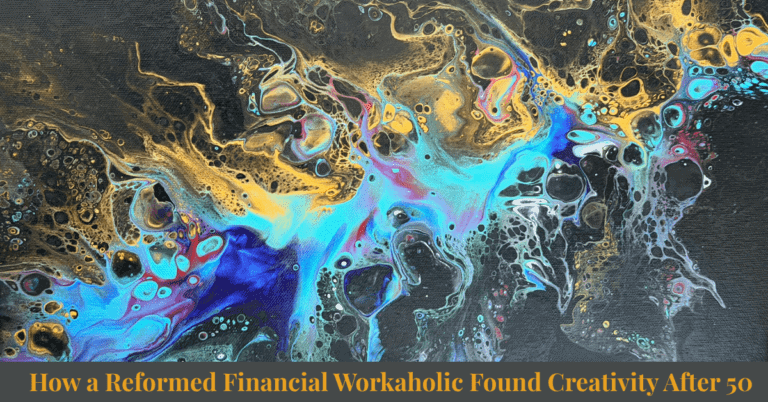
I cannot draw. I want to be clear about this upfront. My stick figures look like crash test dummies that lost. I am a CFO who has spent decades in spreadsheet land managing nearly two dozen companies, and the closest thing to art in my daily life is a particularly elegant Excel formula.
So when my chiropractor Dr. Molly looked at me one afternoon and said, “Are you an artist?” I laughed out loud.
I was in her office because I was wound tight. Work had been particularly relentless, and apparently it was visible from across the room. Dr. Molly is an energetic, perceptive person and she could read me like a balance sheet. She said she saw me doing something chaotic with color. Some kind of painting, she thought.
I told her about the stick figures.
She was undeterred. I’d written about creativity in midlife before, theoretically. This was a chiropractor seeing something in me I couldn’t see myself.
Here’s the thing I didn’t tell her in that moment: earlier that same day I had scrolled past a Dutch Pour painting video on Facebook and thought, almost involuntarily, huh, that looks interesting. Then I’d kept scrolling. But the image had stayed somewhere in the back of my brain, waiting.
When Dr. Molly described chaotic color, I heard myself say, “I actually just saw this video this morning. Do you think I should try that?”
She said yes.
I went home and got on Amazon.
What Happened in the Backyard With a Blow Dryer
I ordered paint. I ordered pouring medium. I ordered canvas boards instead of canvases because I didn’t know yet that there was a difference, and I didn’t care, I had gusto and a Prime membership and that was enough. I watched a couple of videos. I set up a table outside, covered it with something, mixed my colors, and started pouring.
Then I took a blow dryer to it.
And something happened that I was completely unprepared for.
It was magical. I was hooked before the paint was dry.
That first piece, I was so thrilled with it. Genuinely, completely thrilled. I thought I had made something extraordinary. I kept it. I kept all the early ones, in fact, unwilling to throw away anything that had cost me paint and a canvas board and that particular afternoon.
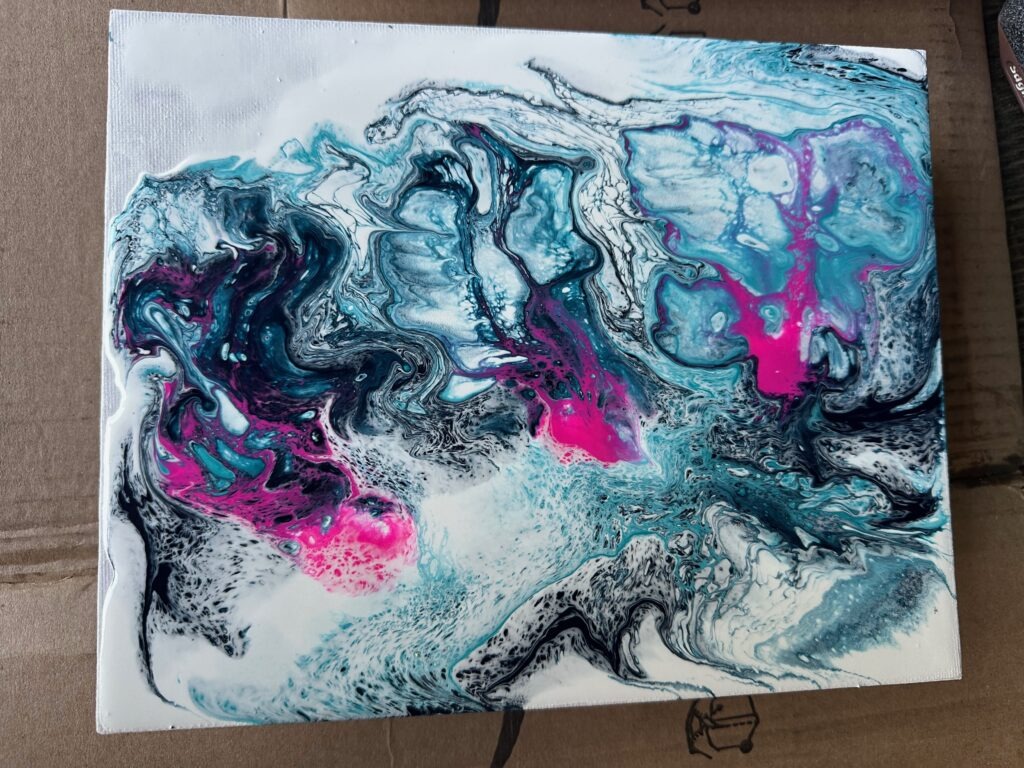
Time passed. I kept painting. I got better, significantly better, as it turned out. And when I went back to those early pieces with more experienced eyes, they were. not what I remembered. The growth was visible and slightly humbling.
I took pictures of all of them before I finally let them go.

What Creativity After 50 Actually Looks Like (From the Inside)
I’ve gotten serious about Dutch Pour since that first afternoon with the blow dryer. Serious enough to complete Olga Soby’s full online course, which involves a proprietary two-viscosity paint method. Level 1 and Level 2 paints layered in a specific way to produce either blending or cells, depending on how you’ve built your pour. I can’t tell you the formula. I took an oath. I’m not even joking.
What I can tell you is what happens in the minutes before you start blowing.
You’ve picked your colors, and color selection is its own creative act, imagining how they’ll move against each other, which ones will blend and which will separate into those gorgeous floating cells. You’ve mixed your paints to the right viscosity, which takes longer than you’d think and involves more cups than seems reasonable. You’ve layered everything on the canvas in the order that matters.
And then you pick up the blow dryer and you genuinely do not know what is about to happen.
There’s anticipation. There’s excitement. And there’s a little fear, because paint isn’t cheap and canvases aren’t infinite and a lot of work went into those cups of color. In the Dutch Pour communities I’ve found online, you hear women say “oh no, no, no!” when a pour goes sideways. You feel that. You know that feeling.
But here’s what I’ve learned: abundance changes everything.
A spreadsheet person who cannot draw, and it still worked.
Doing one thing that’s only yours is one of five small moves in Unfade, my free guide to being seen again after 50. The rest are just as small. Includes a 7-day companion.
Get Unfade, freeWhen canvases were a finite resource I was afraid to waste them. The fear lived in every pour. Then someone gave me more canvases for my birthday, a lot more, and something shifted. With abundance came permission. With permission came actual flow. That shift from scarcity to permission showed up everywhere in my creative work. Living it with a blow dryer in my backyard was a different education than anything I’d read about creativity in midlife.
I stopped being so careful and the work got better. Now I throw out pieces without ceremony. My problem is I have too many canvases and I’m considering donating them the next time someone needs something for a fundraiser.
I have an Etsy shop. Nothing has sold. That’s okay.
All of this happens around a full-time job, by the way. Being a weekend artist is its own discipline, and I wrote about how I protect it.
What the CFO Brain Does During a Pour
Mihaly Csikszentmihalyi spent decades studying what he called flow, that state of complete absorption where challenge meets skill and time stops behaving normally. He was describing something real. I know because I’ve been in it, repeatedly, in my backyard with a blow dryer.
The CFO brain is a relentless machine. It categorizes, tracks, reconciles, anticipates problems, manages risk across nearly two dozen companies simultaneously. It does not stop easily. Meditation helps. Sleep helps. But there is something specific that happens during a Dutch Pour that I haven’t found anywhere else, and I wrote about where joy really lives for women at this stage in my happiness after 50 piece if you want the longer version of this thread.
What Dutch Pour gives me that nothing else quite does: the outcome is genuinely unknown, the process demands total attention, and control is not available as an option.
You cannot will the paint to do what you want. You can only respond to what it does. That is not a natural state for someone whose entire professional life is built on controlling outcomes. It is also, I’ve discovered, an enormous relief.
Flow isn’t something you schedule or force. It arrives when the challenge is real, when the skill is engaged, and when you let go of needing to know what happens next. For me it arrives somewhere between picking up the blow dryer and watching the first cell form in the paint, that moment of pure not-knowing that turns out to be the whole point.
I found it by accident in a chiropractor’s office on a bad work day, pointed there by a video I’d half-watched that morning and a doctor who saw something in me I hadn’t seen yet.
What I’d Tell You
Creativity after 50 doesn’t require talent. It required me to order canvas boards instead of canvases because I didn’t know better, mix paint in too many cups, and stand in my backyard with a blow dryer hoping for the best.
It requires a thing that’s just hard enough that you have to pay attention. A thing where the outcome isn’t guaranteed. A thing where the control freak in you has to step back and let something happen.
Maybe it’s paint. Maybe it’s a garden or a recipe or a song you’re learning note by note. The medium doesn’t matter. What matters is that moment of genuine not-knowing, the blow dryer going on, the paint moving, the cells forming or not forming, and you standing there completely present because there is nothing else you can do.
That presence, demanded by the work rather than scheduled into a calendar, is the gift I didn’t expect. It’s what being truly present feels like when it arrives on its own terms rather than something you have to manufacture.
I threw out my first paintings. I took pictures first.
That’s the whole story of getting better at anything, isn’t it.


