

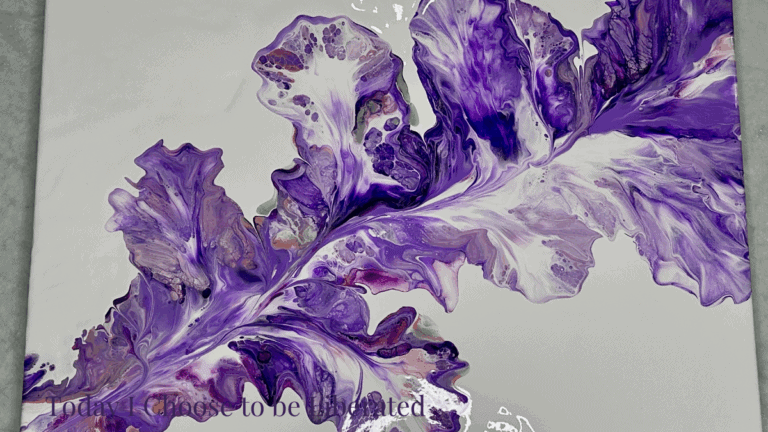
For 40 years, I carried a truth about myself that felt as fixed as my eye color: “I’m not artistic.” I’d say it with a self-deprecating laugh at parties, in meetings, whenever creativity came up. “Can’t even draw stick figures,” I’d joke, as if making fun of myself first would somehow protect me from others noticing this fundamental deficiency.
Then one night, at 59, scrolling through YouTube while avoiding something actually important (probably taxes or that compliance report), I saw a video of someone doing Dutch pour painting. The paint flowed across the canvas in rivers of color, creating patterns that looked like galaxies, or oceans, or abstract dreams. No brushes. No precision. No control.
My chiropractor had been nagging me for months to try something creative for stress relief. “You need an outlet that isn’t spreadsheets,” she’d said, manipulating my spine while manipulating my resistance. I’d nodded and ignored her, because what was the point? I wasn’t artistic. That door had been closed and locked since elementary school when Mrs. Henderson held up my tree drawing and asked if it was supposed to be broccoli.
But something about that Dutch pour video called to me. Maybe it was the lack of control. After decades of managing every detail, every outcome, every variable in my professional life, the idea of letting paint decide where to go felt… liberating.
The First Pour
I ordered supplies that night. Not tentatively, not one or two colors to test. I went full chaos mode – twenty colors, five canvases, all the mediums and additives the YouTube lady recommended. If I was going to fail at art, I was going to fail spectacularly.
Curtis found me in the garage at midnight, wearing his old work shirt, surrounded by paint bottles like some kind of craft store crime scene. “What are you doing?” he asked, in that careful tone husbands use when they find their wives doing something potentially expensive or insane.
“Liberating myself from 40 years of artistic imprisonment,” I said, mixing paint with something called “pouring medium” that looked like school glue but cost four times as much.
He wisely retreated.
The first pour was terrible. And magical. And terrible. The colors muddied in places, ran off the canvas in others. But in one corner, where the turquoise met the gold, something extraordinary happened. It looked like the shallow waters of a beach I’d never seen but somehow remembered. It looked like possibility.
The Liberation of Letting Go
Here’s what nobody tells you about liberation: it’s terrifying. When you’ve defined yourself by your limitations for decades, breaking free feels like betraying some fundamental contract you signed with the universe. I was the woman who couldn’t do art. That was my role. My identity. My excuse for never trying.
But with each pour, each wild collision of color, I felt something loosening. Not just the belief that I couldn’t create, but the whole framework of can’t that I’d built around myself. Can’t do art. Can’t take risks. Can’t waste time on “frivolous” things. Can’t be spontaneous. Can’t trust the process. Can’t let go of control.
The paint didn’t care about my can’ts. It flowed where it wanted, created what it wanted, became beautiful or muddy or surprising without asking my permission or requiring my skill. All I had to do was tilt the canvas and watch.
The Ripple Effect of One Liberation
Within a month, I had twenty paintings. Some were disasters that went straight to the trash. Others stopped people in their tracks. But more importantly, the liberation from “I’m not artistic” began spreading to other imprisoned parts of my life.
If I could be artistic after 40 years of not being artistic, what else was possible?
Could I be spontaneous after decades of rigid planning? I booked a weekend trip with two days’ notice.
Could I be vulnerable after a lifetime of armor? I published a blog post about my menopausal meltdowns.
Could I prioritize joy over productivity? I spent an entire Sunday painting instead of catching up on work.
Each small liberation cracked open another possibility. It was like discovering that the prison I’d been living in had unlocked doors the whole time – I’d just never thought to try the handles.
The Resistance to Liberation
Not everyone celebrates your liberation. When I showed my paintings to certain friends, I got responses like, “Oh, you’re going through an art phase,” or “Must be nice to have time for hobbies,” or my personal favorite, “Well, it’s no Monet.”
No kidding it’s no Monet. Monet never had the liberation of being terrible at something for 40 years and then discovering he could do it anyway.
Some people need you to stay in your box because it helps them feel secure in theirs. Your liberation threatens their carefully constructed reasons for staying imprisoned. If you can suddenly be artistic at 59, what’s their excuse for not trying whatever they’ve declared themselves incapable of?
Liberation vs. Skill
Important distinction: Liberation doesn’t mean you’re suddenly good at something. My paintings are not hanging in galleries. No one’s commissioning my work. Sometimes I still create absolute disasters that look like someone sneezed paint onto canvas.
But liberation isn’t about being good – it’s about being free. Free to try. Free to fail. Free to create ugly art that makes you happy. Free to redefine yourself at any age.
I am liberated from the need to be good at art. I just get to do art. The verb, not the noun. The process, not the product. The joy, not the judgment.
The Physical Sensation of Freedom
Liberation has a feeling in your body. It’s like taking off a too-tight bra after a long day (if you know, you know). It’s the sensation of expansion, of breathing room, of space you didn’t know you were missing until you have it.
When I paint now, I feel it in my shoulders – they drop about three inches. My jaw unclenches. My breathing deepens. My inner critic, that harpy Nagatha Christie, who’s been narrating my inadequacies since 1964, goes quiet. Not silent – she still pipes up with “that color is muddy” – but quiet enough that I can respond with “so what?”
Late-Life Liberation
There’s something particularly sweet about liberation that comes later in life. At 61, I don’t have to prove anything to anyone. I’m not building a career as an artist. I’m not trying to impress potential partners or establish my identity. I’m just a woman who discovered she could paint, decades after deciding she couldn’t.
This kind of liberation is pure. It’s not strategic or calculated or goal-oriented. It’s liberation for liberation’s sake. Freedom for the joy of being free.
Young people liberate themselves to become something. Older people liberate themselves to be something they already were but didn’t know.
The Ongoing Practice
Liberation isn’t a one-time event. Those old beliefs, those can’ts, they have deep roots. Sometimes I still catch myself saying, “I’m not really artistic, I just do paint pouring.” As if there’s some hierarchy of real art versus what I do.
But then I go to my garage studio (yes, I have a studio now, even if it shares space with the lawn mower), and I pour paint onto canvas, and I watch colors dance and merge and separate, and I remember: This is what liberation looks like. Messy. Imperfect. Absolutely free.
The Liberation List
Since the Dutch pour discovery, I’ve been making a list of other imprisonments to break:
- “I’m not a tech person” – Started learning digital art last month
- “I can’t wear bright colors” – Bought a hot pink jacket that Curtis says looks “very liberated”
- “I don’t like spicy food” – Tried Thai level 3 and survived
- “I’m not spontaneous” – Drove to the beach on a Tuesday because the sky was pretty
- “I can’t dance” – Still true, but now I do it anyway
Each liberation makes the next one easier. It’s like my soul is building liberation muscle memory.
Today’s Choice
Today I choose to be liberated. Not from external constraints – those are real and require different kinds of action. But from the internal prisons I’ve built and maintained and decorated so beautifully I forgot they were cells.
I choose to be liberated from my own definitions of who I am and what I can do. From the stories I’ve told myself so many times they calcified into facts. From the comfort of limitations that excuse me from trying.
At 61, I’m learning that liberation isn’t about breaking free from something outside yourself. It’s about realizing you’ve been holding the keys the whole time, jangling in your pocket while you complained about being locked in.
The Dutch pours taught me this: Sometimes liberation is as simple as pouring paint and tilting canvas. Sometimes freedom comes from letting colors flow where they want instead of where you think they should go. Sometimes the most profound revolution is discovering that something you believed about yourself for 40 years was just wrong.
I’m not artistic? Watch me pour this paint. Can’t learn new things at my age? Watch me try. Too old to reinvent myself? Watch me liberate another piece of my soul from the museum of fixed beliefs I’ve been curating since childhood.
Today I choose to be liberated. One pour, one belief, one can’t-turned-into-can at a time.
“Today I Choose to Be” – 365 Daily Intentions →
✨ More Daily Intentions:
- → Today I Choose to be Experimental
- → Today I Choose to be Equitable
- → Today I Choose to be Reflective
- → Today I Choose to be Bountiful
- → Today I Choose to be Generous
📚 Get the Complete Guide: “Today I Choose to Be” – 365 Daily Intentions

