

Affiliate disclosure: some links in this article are affiliate links, which means I may earn a small commission if you buy through them, at no extra cost to you. It never changes what I recommend.
In October 2024, my husband Curtis came home from two weeks in the ICU and sat down on our couch. The kids were all there. Mom and Kurt too. And we started telling him everything he’d said and done while he was out of his mind with ICU psychosis, the PICC lines he’d pulled out, the NG tubes, the business schemes he’d been hatching with the nurses and doctors, apparently convinced they were there to negotiate deals.
And then we got to the ship.
“We’ve got to get off the ship,” he’d told me, urgently, in the ICU.
“Of course, honey,” I’d said, because what else do you say. “We’ll get off the ship.”
“But first we need to cut a piece of the calf and give it to the Captain.”
I’d looked at him. He’d looked back at me like I was an utter idiot.
“The Captain’s daughter’s calf,” he said. Obviously.
Sitting on the couch, hearing this story for the first time, Curtis was incredulous. He remembered none of it. And we laughed, really laughed, in a way I hadn’t in weeks. Maybe months.
That moment didn’t feel like happiness the way I used to define it. There was no milestone. No goal achieved. No box checked. Curtis was thin and exhausted and we had a very long road still ahead of us. Nothing was fixed. Everything was still uncertain.
And yet.
I’ve spent a good part of my adult life curious about joy, what it is, where it comes from, why it shows up when it does and disappears when you need it most. I’ve read the books. The Book of Joy with the Dalai Lama and Desmond Tutu, both of them laughing through their own impossible circumstances. Daniel Gilbert’s Stumbling on Happiness, which quietly dismantled everything I thought I knew about what would make me happy. Eckhart Tolle on the joy of simply being, which I understood intellectually for years before I understood it in my body.
But it was that couch, that story about the Captain’s daughter’s calf, that finally made it land.
I had spent decades believing joy was something you earned. A promotion. A goal reached. A problem solved. And because I’d built my happiness on milestones, I could only be happy when I was hitting one, which, if you do the math, means I was leaving an enormous amount of joy completely unclaimed.
The quiet that came with Curtis’s recovery changed that. Not because it was peaceful, it wasn’t, not even close, but because it stripped everything down to what was actually real. And what was real, it turned out, was full of joy. Just not the kind I’d been looking for.
This is what I’ve learned about happiness after 50. Not from a study or a framework, though the science is genuinely fascinating and we’ll get to it. From a couch. From a ship story. From an ant I watched carry a feather across a pool deck and felt something close to wonder.
Joy was always here. I just had to get quiet enough to see it.
Why We’re So Wrong About What Makes Us Happy
Daniel Gilbert has a theory about happiness that I wish someone had handed me at thirty. In Stumbling on Happiness, he makes the case that humans are genuinely terrible at predicting what will make them happy, and equally bad at remembering the past accurately. We forecast joy wrong. We rewrite our memories to be rosier than they were. We are, as a species, confidently mistaken about our own emotional futures.
I am Exhibit A.
For years I told myself that making it to the C-suite would be the thing. CFO. Managing companies at the highest level. I worked toward it, absorbed everything I could, said yes before I knew how, and eventually got there. And I am proud of it, genuinely. I’m grateful for what it offers and what it took to build. But the joy? It was brief at best. Maybe it wasn’t even joy. It was more like accomplishment with a side of heavier workload. The title arrived and then immediately the work expanded to fill every corner of the life I’d imagined enjoying once I got there.
Gilbert would not be surprised.
His research shows that we chronically overestimate how happy good things will make us and how devastated bad things will make us. We think the promotion will change everything. We think the diagnosis will ruin everything. And then life continues, quieter and more textured than our predictions, and we adapt, which is both the best and most humbling thing about being human.
The flip side surprised me just as much.
A couple of years ago Curtis wanted to go to a Christmas party with his networking group. I am what I call a gregarious introvert, I can work a room, but I need three days alone afterward to recover. I didn’t know most of these people. I faced that party with what I can only describe as a mild existential dread. But I wanted to be a supportive wife, so I went, and I made myself a quiet promise: I would just listen. Really listen. Not perform, not network, just be genuinely curious about whoever I ended up talking to.
I still get goosebumps thinking about what happened. One deep conversation became another. People shared things they probably didn’t expect to share at a Christmas party. I left that night with a sense of joy and awe I was completely unprepared for. I had predicted an evening of polite survival. What I got was one of the most connecting nights I can remember.
There’s actually a name for this pattern. Gilbert calls it “miswanting”, wanting the wrong things because we’re imagining the wrong futures. We want the title, the win, the milestone. We dread the party, the unknown room, the quiet season with no achievements on the calendar. We’re so busy forecasting the wrong joys and the wrong disasters that we miss what’s actually available to us right now.
I wrote about how we can train our brains for joy if you want to go deeper on the psychology behind all of this.
What Your Brain Is Actually Doing (And How to Work With It)
Here’s the part where I get to tell you that hugging your dog is scientifically justified.
When you pet an animal, really pet them, slow and intentional, your brain releases oxytocin, the same bonding hormone that surges during a hug with someone you love. I know this, and so every morning Roo gets long, deliberate hugs and kisses that he tolerates with the patient dignity of a dog who understands his role in my wellness stack. It’s not indulgence. It’s biology. I’m just working with the system.
Your brain runs on a handful of neurotransmitters that regulate how happy you feel on any given day. Serotonin is the steady one, it keeps you calm, content, feeling like things are basically okay. Dopamine is the exciting one, it fires when you accomplish something, finish a task, check a box. Oxytocin is the connection one, it flows during physical touch, genuine conversation, moments of trust. Endorphins are the relief ones, they surge during laughter and exercise and, it turns out, dancing.
The interesting thing is that you can intentionally trigger all of them. Not manipulate, trigger. There’s a difference. You’re not tricking your brain. You’re giving it what it was designed to respond to.
My most reliable serotonin delivery system is a song called Celestial BeBop. Dancing in Heaven, by Q-Feel. I’ll tell you what it cost me in the movement section. Worth every cortisone shot.
Dopamine, meanwhile, is hiding in your to-do list. Every item you cross off releases a small burst of it. This is why I’m a devoted list-maker, not because I’m organized (ask anyone who works with me) but because the checkmark itself is a reward. Your brain doesn’t distinguish between finishing a quarterly report and finishing a grocery run. It just knows you finished something, and it likes that.
And endorphins? Laughter. Movement. Both together if you can manage it. Which brings me back to Curtis on the couch, laughing about the Captain’s daughter’s calf. That wasn’t just a nice moment. That was oxytocin and endorphins and serotonin all showing up at once, uninvited, in the middle of the hardest season of our marriage.
Your brain is always looking for reasons to give you these chemicals. The older I get, the more I think our job is simply to stop making it so hard. Meditation is one of the most reliable ways I’ve found to work with my brain rather than against it.
The Hedonic Treadmill. And How I Rode It For Decades
There’s a concept in happiness research called the hedonic treadmill. The idea is simple and a little brutal: we achieve something, feel a burst of happiness, and then adapt. The new thing becomes the normal thing. And almost immediately we start looking for the next thing that will finally, permanently, do it.
I have been on this treadmill my entire adult life. I just didn’t know it had a name.
At eighteen I was in Amway, completely convinced I would be a millionaire by thirty and then, then, I would be happy. Thirty came. The millionaire part had not materialized, so I reset the target. If I could find the right man, I’d be happy. If I could find a better job, I’d be happy. In 1996 I bought my first house and thought, surely this is it. My own house. This will do it.
It did it, briefly. And then it was just my house, and I needed the next thing.
I read The Secret somewhere in there, and one passage lodged itself in my brain, the one where they tell you to close your eyes and imagine yourself sitting in a BMW, your hands on the leather steering wheel, the engine roaring to life. I didn’t even know I liked BMWs. But I followed the instruction, felt whatever I felt, and apparently manifested with some commitment because I have now owned three of them.
The first one was a white convertible. Gorgeous. I was thrilled, until it rained and I hydrolocked the engine, which takes some of the shine off a car. That one went off lease and I got another BMW, which also made me happy, though it wasn’t a convertible so I was measurably less happy than I’d anticipated. Now I own my third, paid off, and I intend to drive it into the ground.
Here is what I can tell you: a paid-off BMW makes you happier than a leased one. That part is true.
But here’s what’s also true: none of them delivered the permanent, settled happiness I was reaching for. Each one was wonderful and then, fairly quickly, it was just my car. The treadmill kept moving.
Psychologists call this adaptation, the process by which we return to our baseline happiness level regardless of what happens to us, good or bad. It’s why lottery winners report similar happiness levels to non-winners within a year. It’s why the promotion feels electric for a month and routine by three. It’s not a character flaw. It’s how we’re wired.
The problem isn’t the treadmill. The problem is mistaking it for a path that leads somewhere.
What I know now, at nearly 62, is that the treadmill doesn’t stop, but you can step off it. Not by achieving more, but by looking differently. Roo on the couch knowing something is wrong before I do. Curtis laughing at himself about a ship he doesn’t remember being on. Moments that cost nothing and deliver everything.
Positive thinking after 50 is part of this shift, not toxic positivity, but genuinely retraining where you look for the good.
Connection Is Where Joy Actually Lives
I want to tell you about a moment in a hospital hallway at HCA Trinity that I think about more than almost anything else from that season.
Curtis had been moved from a regular floor to the ICU. His surgeon Rick had told us it was just for better coverage, monitoring, nothing alarming. I believed that. The next day, after they got Curtis settled, Rick came out to give us an update. I looked at him and asked the question you ask when you already know the answer is yes: “But he’s going to be fine, right?”
There were tears in Rick’s eyes.
“I can’t tell you that,” he said.
“That’s not what you’re supposed to say, Rick.”
“I know. But I can’t tell you that.”
My mother-in-law and I burst into tears in that hallway. And somewhere in the middle of that moment, a thought formed that was so clear it felt like it had always been true: if he makes it through this, there is nothing he can do that will upset me ever again.
Fast forward to May 2026. That is mostly true. Unless he leaves the toilet seat up in the middle of the night. Then I can still get angry. But other than that, genuinely, there is very little.
What nearly losing someone does to a relationship is hard to describe without sounding like a greeting card, so I’ll try to be specific instead. The old hurts and resentments didn’t fade gradually. They just became irrelevant, almost overnight. I couldn’t even remember what they were. What I could remember, what came flooding back with startling clarity, was every moment of genuine connection. Every funny thing he’d ever said. Every time he’d been steady when I was fraying. Every ordinary evening that I’d somehow failed to register as the gift it was.
What remained was just love, uncomplicated and clear.
Connection showed up everywhere during that season, not just with Curtis. My kids were extraordinary, showing up, picking me up, cheering me up, planning outings, making me laugh when laughter felt like a distant memory. Any small annoyance, any old tension, any moment I’d catalogued as a grievance, gone.
My neighbors showed up in ways I didn’t expect and won’t forget.
And then there was Roo, who apparently runs on instinct I don’t have, sensing when something is wrong before I do, showing up accordingly, and collecting his oxytocin payment in the morning without fail.
The quiet taught me something else, too: I’d gone a little invisible to myself.
Unfade is the free guide that came out of that season, five small ways to be seen again after 50, starting with the one person who stopped looking. Plus a 7-day companion.
Get Unfade, freeThe chickens, I’ll admit, came with complications I did not anticipate. Rats, for instance. Nobody tells you about the rats. But I would not give them up for anything, not Lelu, who walks into the house like she owns it and has never once questioned whether she belongs there; not Stevie Chicks, who is a true chicken in the best sense, actually scratching for her food with focused agricultural purpose; and certainly not Morticia, who stands slightly apart from the others, assessing everything with an expression that suggests she has opinions and is deciding whether you’re worth sharing them with.
Watching them brings me genuine daily joy. The kind that costs nothing. The kind that’s always available if you remember to look.
Connection doesn’t require grand gestures or perfect relationships or people who never leave the toilet seat up. It requires presence. Attention. The willingness to let what matters actually matter, instead of keeping score of what doesn’t. The science of self-compassion is worth sitting with here, because how we treat ourselves shapes how openly we can show up for everyone else.
The Small Ordinary Joys Nobody Tells You To Notice
Two evenings ago I was in the pool after work, arms crossed on the edge, essentially at ant level, while Curtis sat in a chair nearby. That’s when I first saw him.
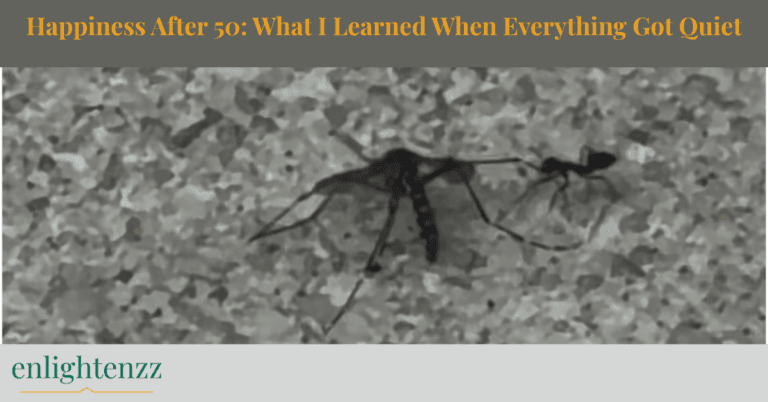
An ant. Carrying a dead mosquito that was, by any reasonable measure, too large to be carried by one ant. What followed was what I can only describe as a saga, this tiny ant navigating the entire pool deck with his cargo, other ants arriving to thwart him, him stalwartly continuing anyway, unbothered, committed, magnificent. I watched for a long time. Then I videoed it and sent it to my kids with the energy of someone who had witnessed breaking news.
They did not respond. I called them. Jesse and Amy, once reached by phone, rose to the occasion. “We laughed.we cried.the triumph was awe inspiring,” Amy texted afterward. “He should be an inspirational poster.” She’s not wrong.
I texted back: “There’s a lesson there right? NEVER SAY DIE!”
The ant would agree.
Last night, same scenario, post-work, in the pool, arms on the edge. He was back. An ant, this time carrying a feather. And before you say anything, I know it was the same ant. You could tell by the attitude. By the tenacity. By the particular stalwartness of his bearing. I videoed this one too and sent it to the kids, who this time had the sense to respond appropriately.
I watched that ant for a long time. And what I felt, watching him, was something close to wonder.
This is what nobody tells you about happiness after 50: some of the best of it is tiny. Not metaphorically tiny, literally tiny. An ant. A feather. A baby woodpecker showing up at the feeder wanting to be fed, still figuring out how the world works. Morticia, doing what Morticia does.
These moments don’t make the highlight reel. They don’t feel like achievements. They don’t move any needle you’ve been told to care about. They’re just there, available, every single day, waiting for you to get quiet enough and low enough, pool-edge level, maybe, to notice them.
The research on this has a name: savoring. The deliberate practice of attending to and appreciating positive experiences as they happen, rather than rushing through them toward the next thing. People who regularly savor ordinary moments report significantly higher life satisfaction, not because their lives are better, but because they’re actually present for the lives they have.
I spent decades moving too fast to savor anything. There was always a next thing, a next goal, a next version of arrival. The ant would have been invisible to that version of me. Getting quiet, really quiet, the way Curtis’s recovery forced me to get quiet, changed my vision. Not metaphorically. Literally. I started seeing things I’d been walking past for years.
Joy at this stage of life isn’t smaller than it used to be. It’s actually larger, because it’s everywhere. You just have to be willing to stop, get to ant level, and pay attention. Even if your kids don’t text back immediately. They’ll come around. Choosing to be joyful is a practice, not a personality trait, and it starts with exactly this kind of noticing.
What Actually Helps. The Practices That Work
My gratitude practice starts before I get out of bed. Deliberately.
Here’s the thing about my bed in the morning: it is the most comfortable it will be in the entire world. The sheets are warm, the mattress has conformed to exactly where it needs to be, Roo is curled against me, Curtis is next to me, and absolutely none of this will be true again until tomorrow. Getting up for work is a biological injustice I face every weekday. So I made a deal with myself, I would use the not-wanting-to-get-up as the practice itself.
I lie there and I start my list. It begins the same way every morning:
Thank you for letting me be born in this country. Thank you for my biological mother making the choice she made. Thank you for letting me be here.
And then it expands. The cozy bed. The sheets at exactly the right temperature. The dog. My husband. My kids. My friends. My job, complicated as it sometimes is. I don’t run through these like items on a checklist, I actually feel them. There’s a difference between saying the words and letting the gratitude land in your chest, and I’ve learned to go for the landing.
By the time I get up, my head is in a different place than it would have been if I’d grabbed my phone first. I wrote about how gratitude actually works if you want to build the practice deliberately, it goes deeper on the science behind why this changes things.
That first hour of the day earned its own piece. My positive morning routine is the version that actually works at 5:47 a.m.
Mindfulness is the practice I have to keep reclaiming. I spent decades eating at my desk, moving through meals like they were obstacles between tasks, not paying attention to anything that wasn’t demanding my attention. Rote mode, I call it. It’s efficient and it’s also a way of being absent from your own life for years at a stretch.
Now, after my morning routine, I take my coffee outside. I sit where I can feel the sun on my face. I hold the cup and feel its warmth in my hands. I look at my backyard, really look at it. On cooler mornings you can see the steam rising off the coffee, and that alone is worth stopping for. The taste of it. The temperature of the air. The specific quality of early morning light in Florida that doesn’t exist at any other time of day.
I’ve also discovered, somewhat accidentally, that lupini beans are a mandatory mindfulness practice disguised as a snack. You cannot eat a lupini bean on autopilot. First you get the hit of lemon and salt and acid all arriving at once. Then you have to pop the bean out of its shell, discard the shell, eat the bean. They demand your full attention every single time. They’re also extremely high in protein, which means they’re good for you, which means I feel virtuous while being forced to be present. I’ve made them with lemon juice, olive oil, salt, pepper, genuinely delicious, and genuinely impossible to rush.
The other day I made a simple salad, tomatoes, cucumbers, onions, green onions, lemon juice, olive oil, salt, pepper, oregano, and I slowed down enough to actually taste it. It was extraordinary. Not because the salad was extraordinary, but because I was paying attention. Being mindful is a choice you make a hundred small times a day. The lupini bean just makes it easier.
Movement is where I want to be careful to tell the truth, because the wellness world collapses joy and accomplishment into the same category and they are not the same thing.
The Smith machine brings accomplishment. The rowing machine brings accomplishment. The Pilates reformer, which I refer to as Satan, because it has earned that name, brings nothing but suffering and the grim satisfaction of having survived it. These things are good for me and I do them and I feel better for having done them. That is not the same as joy.
Joy is walking with Roo. He is small. We go slowly. And that slowness is the whole point, it gives me time to notice my neighbor’s flower garden, the architecture of a house I’ve walked past a hundred times, the oak trees that have been standing on this street longer than any of us have been alive. Roo stops to investigate things I would have stepped over without a thought. I’ve started stopping with him.
Joy is also dancing in the kitchen to Celestial BeBop. Dancing in Heaven, by Q-Feel, which I rediscovered after twenty years and played on repeat until my family staged what I can only describe as a noise intervention. I danced myself into Plantar Fasciitis, three cortisone shots in my heel, and twelve pairs of Vionics, which, for anyone who needs arch support and has been wearing sad orthopedic shoes since 1987, are genuinely cute and worth knowing about. Worth it. Always worth it.
The practices that reliably deliver happiness after 50 share one quality: they require you to slow down enough to be present for them. Gratitude in a warm bed. Coffee and steam and morning sun. An ant carrying a feather. A lupini bean that won’t let you rush.
Joy doesn’t hide. It just requires a different pace than the one most of us have been running at.
What I’d Tell You Now
I spent most of my adult life believing joy was something you arrived at. A destination with a specific address, the right title, the right house, the right car, the finish line of whatever race I was currently running. I was wrong about this for decades, and I was wrong about it with tremendous commitment and energy.
Here is what I know now, at nearly 62, that I wish I’d known at 30.
Joy is not waiting at the top of anything. It was never there. I checked repeatedly.
What’s actually there, what has always been there, available every single day without requiring an achievement or a milestone or a BMW, is smaller and more ordinary and more reliable than anything I spent those decades chasing. It’s a dog curled against you in a warm bed while you count your blessings before the alarm goes off. It’s steam rising off a coffee cup on a cool Florida morning. It’s an ant on a pool deck, carrying something twice his size, absolutely unbothered by the impossibility of it, and the text thread with your kids that follows because some things are too good not to share.
It’s Curtis on the couch, laughing at a ship he doesn’t remember being on, present and aware and home.
I don’t think I could have learned this any other way. I needed the hedonic treadmill to exhaust itself. I needed to stand in a hospital hallway and hear a surgeon say “I can’t tell you that” before I understood what actually mattered. I needed to get quiet, really quiet, the kind of quiet that a crisis forces on you whether you want it or not, before I could hear what had been available all along.
The science supports all of this. The neuroscience, the positive psychology, the research on relationships and savoring and gratitude, it all points the same direction. Toward presence. Toward connection. Toward the ordinary moments you keep stepping over on your way to somewhere else.
But honestly? I didn’t need the science to convince me. I needed the ant.
If I could tell you one thing about happiness after 50 it would be this: stop waiting to arrive. You’re already there. The joy is in the looking, in getting low enough, slow enough, quiet enough to see what’s been sitting right in front of you the whole time.
It always was.


