Affiliate disclosure: some links in this article are affiliate links, which means I may earn a small commission if you buy through them, at no extra cost to you. It never changes what I recommend.
How to Be Bold: A Guide for Women Over 50 Embracing Their Power
We tend to picture boldness as loud, flashy, and fearless, taking the stage, making the deal, leaping without looking. But in real life, boldness often looks very different. Sometimes it’s shaky, messy, and comes out in a trembling voice.
I learned that in a boardroom years ago, when our CEO floated a decision that wasn’t just questionable, it was illegal. My whole body screamed at me to stay quiet. My heart pounded so hard I was sure others could hear it, my palms were slick with sweat, my stomach twisted into knots. Everyone else around the table seemed prepared to nod and move on.
But I couldn’t. Instead, I spoke up. My voice wavered, my words tumbled out more like pleading than polished rhetoric, but I said what needed to be said: “Don’t do this.” The room went still. Some people looked at me like I was “too much,” like I had broken an unspoken rule. And in a way, I had.
That moment taught me something unexpected: being bold isn’t about feeling fearless. It’s about deciding that your values matter more than your fear, even if your voice shakes while you speak them aloud.
Understanding What Real Boldness Looks Like
Learning how to be bold after 50 isn’t just about making dramatic changes, it’s about embracing our authentic selves with confidence and purpose. But society has sold us a cartoon version of boldness that rarely matches reality.
True boldness doesn’t require perfect confidence or flawless execution. It requires something much more accessible: the willingness to act in alignment with your values, even when your body is staging a full revolt against the idea.
Research from psychologist Dr. Brené Brown reveals that vulnerability and courage are intimately connected. The people we perceive as most courageous aren’t the ones who never feel fear, they’re the ones who feel the fear and show up anyway.
Why We Struggle with Boldness (Especially as Women)
From childhood, many women receive mixed messages about boldness. We’re encouraged to be confident but not “too much.” Assertive but not aggressive. Visible but not attention-seeking. By the time we reach our fifties, we’ve internalized years of conditioning that equates being bold with being difficult, selfish, or inappropriate.
That boardroom moment? My body’s rebellion wasn’t just about confronting authority, it was about violating decades of programming that told me to be agreeable, to not make waves, to prioritize others’ comfort over my own integrity.
Neuroscientist Dr. Louann Brizendine explains that women’s brains are actually wired to be highly attuned to social disapproval. When we speak up or stand out, our amygdala, the brain’s alarm system, can trigger intense physical reactions. Those sweaty palms and racing hearts aren’t character flaws; they’re biology working overtime to keep us “safe” within social norms.
The Hidden Costs of Playing Small
While we worry about the risks of being bold, we rarely consider the price of staying small. Every time we swallow our words, dismiss our ideas, or shrink to fit others’ expectations, we reinforce patterns that limit not just our own lives, but the lives of other women watching us.
Research from the Center for Talent Innovation shows that women over 50 are significantly underrepresented in leadership roles, not because they lack capability, but because they’ve been conditioned to wait for permission that never comes. Boldness isn’t about being reckless, it’s about refusing to wait for someone else to validate your right to take up space.
How to Cultivate Authentic Boldness
Start with Your Values, Not Your Comfort Zone: Boldness becomes easier when it’s anchored in something bigger than your fear. That day in the boardroom, I wasn’t motivated by confidence, I was motivated by the knowledge that staying silent would make me complicit. What matters so much to you that you’d speak up even with a shaking voice?
Expect Your Body to Protest: Those physical sensations, the racing heart, sweaty palms, churning stomach, aren’t signs you should stop. They’re signs your nervous system is recalibrating to a new level of authenticity. Learn to recognize the difference between danger signals and growth signals.
Practice Bold in Small Doses: You don’t have to start by confronting CEOs in boardrooms. Practice speaking up in lower-stakes situations. Express an unpopular opinion at book club. Send back food that’s not what you ordered. Wear something that feels “too much” for you. Build your boldness muscle gradually.
Redefine Success: Don’t measure boldness by others’ reactions. Some people looked at me like I was “too much” that day, and you know what? They were right. I was too much for their comfort, and that was exactly the point. Success isn’t about keeping everyone comfortable, it’s about living with integrity.
The Ripple Effects of Female Boldness
When women over 50 embrace boldness, we don’t just transform our own lives, we give permission for others to do the same. Every time you speak up in a meeting, every time you pursue a dream others call “unrealistic,” every time you refuse to shrink, you model possibility for other women.
Your boldness doesn’t have to be perfect or polished. It doesn’t have to come out in a steady voice or with unwavering confidence. It just has to be real. It has to be yours.
When Boldness Feels Too Risky
Not every situation calls for boldness, and wisdom includes knowing when to pick your battles. But too often, we convince ourselves that the stakes are higher than they really are, that speaking up will cost us more than staying silent.
Ask yourself: What’s the real risk here? What’s the worst that could reasonably happen if you speak your truth? Now ask: What’s the cost of not speaking up? What happens to your self-respect, your integrity, your sense of agency when you repeatedly choose silence over authenticity?
Sometimes the biggest risk is not taking one at all.
The Evolution of Boldness
Boldness at 50-plus doesn’t look the same as boldness at 25. It’s less about proving ourselves and more about honoring ourselves. It’s less about changing the world and more about refusing to betray our own values. It’s less about fearlessness and more about fear-friendliness, acknowledging the fear and acting anyway.
That trembling voice in the boardroom? It wasn’t a sign of weakness, it was a sign of courage. It was the sound of someone choosing integrity over ease, truth over comfort, authenticity over approval.
Your Permission Slip for Boldness
You don’t need anyone’s permission to be bold, but in case you’re still looking for it, here it is: You are allowed to take up space. You are allowed to have strong opinions. You are allowed to speak up, stand out, and sometimes be “too much” for other people’s comfort.
Your voice matters, even when it shakes. Your perspective has value, even when others disagree. Your boldness is needed, especially when it feels scary.
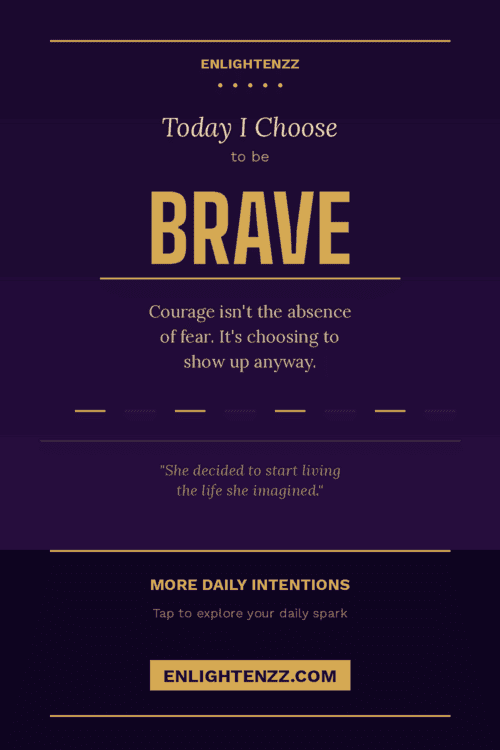
Today, choose to be bold. Not because you feel fearless, but because your values matter more than your fear. The world needs what you have to offer, even if, especially if, it comes with a trembling voice and sweaty palms.
Boldness isn’t about perfect confidence. It’s about imperfect courage. And that’s exactly what makes it so powerful.
🌟 Continue Your Journey:
- Today I Choose to be Regulated
- Today I Choose to be Synchronized
- Today I Choose to be Decisive
- Today I Choose to be Willing
- Today I Choose to be Exhilarated
📚 Get the Book: “Today I Choose to Be” – 365 Daily Intentions
If boldness had an instruction manual, I’d have read it twice and still gotten it wrong. Which is why I keep writing my 365-day intentions practice instead of pretending I know.