

A real story about brothers, boundaries, a boy who didn’t make it, and what loving an addict actually costs the people left standing.
I have never written this piece before. Not because I didn’t have the material. I have had the material my entire life, actively loving someone with addiction. But because some stories sit in you for decades before you are ready to let them out into the light.
This is one of mine. It is about loving someone with addiction, and what it costs the people left standing.
The Brother I Grew Up With
My brother Jeff did not announce himself as an addict. He arrived, as they all do, as someone I loved first.
He is three years younger than me, adopted like I was, the little brother who completed our complicated family picture. I loved him the way you love someone you grew up alongside, with the particular fierceness that comes from shared walls and shared history and the specific understanding that you are the only two people in the world who had exactly those parents, in exactly that house.
And then, somewhere along the way, drugs arrived and rearranged the whole equation. My parents and I were loving someone with addiction.
What addiction looks like from the inside of a family is not what the after-school specials prepared you for. It is not dramatic at first. It is a missing stereo. My car stereo, specifically, removed while I was sleeping and sold before I noticed it was gone. It is a bicycle disassembled in the night, sold for parts. It is moving in and moving out and moving in again, each time with a story that made just enough sense to believe. It is money borrowed and never returned, not once, not ever, over the course of decades.
It is your brother, whom you love, smoking crack while babysitting your two-year-old son.
That sentence still lands in my chest like a stone. Jesse was two. I trusted Jeff with Jesse. And Jeff, my brother, who I believe somewhere under everything still loves me, made a choice that could have ended in a way I cannot let myself fully imagine even now.
That was the moment the accounting changed for me. Not the end of love. Love is not that simple and neither am I. But the end of a particular kind of trust that, once broken that way, does not grow back.
What Loving Someone With Addiction Does to You Over Time
People who have not lived inside a family shaped by addiction do not understand what it does to the people orbiting it. Not the addict. The people who love the addict. The ones who are sober and exhausted and quietly unraveling while everyone else asks how the addict is doing.
Here is what it does. It makes you hypervigilant in ways that do not turn off when the immediate crisis passes. It makes you a scanner, reading rooms, reading faces, reading the specific quality of silence that means something is wrong before anything has been said. It makes you a person who checks. Who tracks. Who cannot fully relax because experience has taught you that relaxing is when things disappear.
It makes you ashamed of something that is not your fault, which is its own particular cruelty.
Loving someone with addiction makes you an expert at two contradictory skills: loving someone completely and protecting yourself from them simultaneously. Those two things are not supposed to coexist. Learning to hold them both is some of the hardest emotional work I have ever done.
Jeff and I are essentially estranged now. That is the word that fits, though it does not quite capture the texture of it. It is less a clean break than a long, slow loosening. A series of small decisions on both sides that added up to distance. I do not hate him. I think about him. I hope he is okay in whatever way okay is available to him.
But I also know that the version of our relationship that I kept trying to restore, the one where he showed up, where the borrowing stopped, where the trust rebuilt itself, was not a relationship he was capable of being in. Estrangement, in that light, is not abandonment. It is honesty about what is real.
The Night That Broke Something Open
My own history with Jeff is one kind of education. What happened to my friend Sarah is another.
I have changed her name because her grief belongs to her, not to the internet. But the story is real and I want to tell it carefully, because I think it is the story that every woman in this situation carries somewhere in her body, even if it has not happened to her yet. The worst version. The one you cannot come back from.
Sarah called me on Tyler’s twelfth birthday. My son’s birthday party, which she knew about, which is how I understood before she said a single coherent word that something had gone terribly wrong. You do not call someone at their child’s birthday party unless the world has shifted.
Her son had gone to a party the night before. He was eighteen. A senior in high school. Straight-A student his whole life, star of his football team, working full-time at a restaurant. The kind of kid who made everything look possible. The kind of kid nobody worries about. At the party, someone had a fentanyl patch. He ingested it. He passed out.
Here is the part I cannot get past, even now: the people at that party did not call 911. They found him unresponsive and they hooked him up to a blood pressure machine. A blood pressure machine. And they waited.
By the time anyone called for help, there was nothing left to save. He was on life support by the time Sarah got to the hospital. Being kept alive by machines in a room that smelled like antiseptic and the particular fluorescent quiet of places where very bad things happen. I drove there. I stood there with her. I watched her understand, in real time, that her son, her brilliant, football-playing, hardworking boy, was not coming back.
He died of a drug overdose at eighteen. A senior in high school who had never been in trouble, who had never used before as far as anyone knew. One night. One patch. A room full of people who were too scared or too impaired or too young to call 911.
I had to help hold people together that night, friends, family, people who loved him, while also being someone who was watching her best friend’s heart break in a hospital hallway. There is a particular kind of functioning that grief requires of the people on the edges. You hold the ones closest to the center. You make the calls. You find the words. And then you drive home alone at 4 AM and you sit in your car in your driveway and you do not know what to do with what just happened.
What I Know Now That I Wish I Had Known Earlier
Some of you are loving someone whose body is the crisis, I have written about the year I learned to change an ostomy bag for that version of it. Either way, what follows holds.
For the women reading this who are living inside a version of this story right now, whether it is a brother, a son, a daughter, a spouse, a parent, here is what decades of this have taught me.
The love does not go away. Neither does the damage. Both are true at the same time. You are not a bad person for protecting yourself. You are not a cold person for having limits. When you are loving someone with addiction, the love and the boundary can coexist, and learning to hold them both without apologizing for either is some of the most important work you will ever do.
You did not cause it and you cannot cure it. I know you know this. I also know that knowing it intellectually and actually believing it in your body are two entirely different things. Jeff’s addiction is not the product of my failures as a sister. Sarah’s son’s death is not the product of her failures as a mother. Addiction does not target bad families. It targets people. Sometimes eighteen-year-old honor students who work at restaurants and play football and have never given their parents a moment of worry.
The hypervigilance is real and it costs you. The constant scanning, the checking, the inability to fully exhale: that is trauma doing its job. It kept you safe once. It may be keeping you wired in ways that are no longer serving you. Therapy, Al-Anon, honest conversation with people who have lived this: these are not luxuries. They are how you stop passing the cost on to your own nervous system indefinitely.
Fentanyl changed everything. What happened to Sarah’s son is not the overdose story of twenty years ago. Fentanyl is in everything now: pills, patches, powders, things that look like something else entirely. One exposure. One night. One party where nobody called 911. An eighteen-year-old honor student who had done everything right. The stakes of this moment in the addiction crisis are not the stakes most of us grew up understanding. Talk to your kids. Talk to your grandkids. Talk to anyone young enough to be at a party where they might not know what they are touching.
You are allowed to have a life. This is the one that took me the longest. You are allowed to have joy while someone you love is suffering. You are allowed to build something, enjoy something, rest, laugh, thrive. None of that is a betrayal of the person you love. Their recovery, if it comes, is theirs to find. Your life is yours to live. Both things are true. Both things matter.
The Part I Am Still Working On
I am not going to wrap this up too neatly because that would be dishonest. Jeff and I are estranged and I do not know how that story ends. Sarah carries what she carries and I carry it with her in the particular way that close friends carry each other’s worst things.
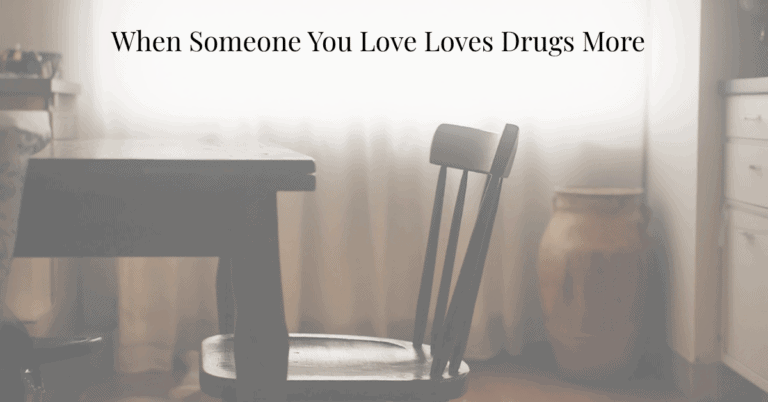
The grief of loving an addict is its own category, what therapists sometimes call ambiguous loss. Grieving someone who is still alive. Holding space for someone who may never fill it. Building a life that is genuinely good while leaving a chair at the table, metaphorically, for the version of them you still hope might someday show up.
That is where I live with this. Not in resolution. In the ongoing practice of loving someone with addiction honestly, protecting myself without shame, and refusing to let someone else’s addiction define the whole shape of my life.
If you are in this, really in it, right now, awake at 2 AM with your phone in your hand, please find your people. Al-Anon exists for exactly this. Therapy exists for exactly this. And women like us, who have been in it long enough to know the landscape, exist to tell you that you are not alone in it and you are not to blame for it and you are allowed to survive it with your own life intact.
That is not nothing. That is, in fact, everything.
If this piece found you at the right moment, I would love to stay in connection. [Join the Enlightenzz community] for women 50+ navigating the full, complicated, beautiful, difficult truth of this life stage.
Susie Adriance is the founder of Enlightenzz.com. She is a CFO, a writer, and a woman who has been around long enough to know that the most useful thing you can do for someone in pain is tell them the truth about your own.


